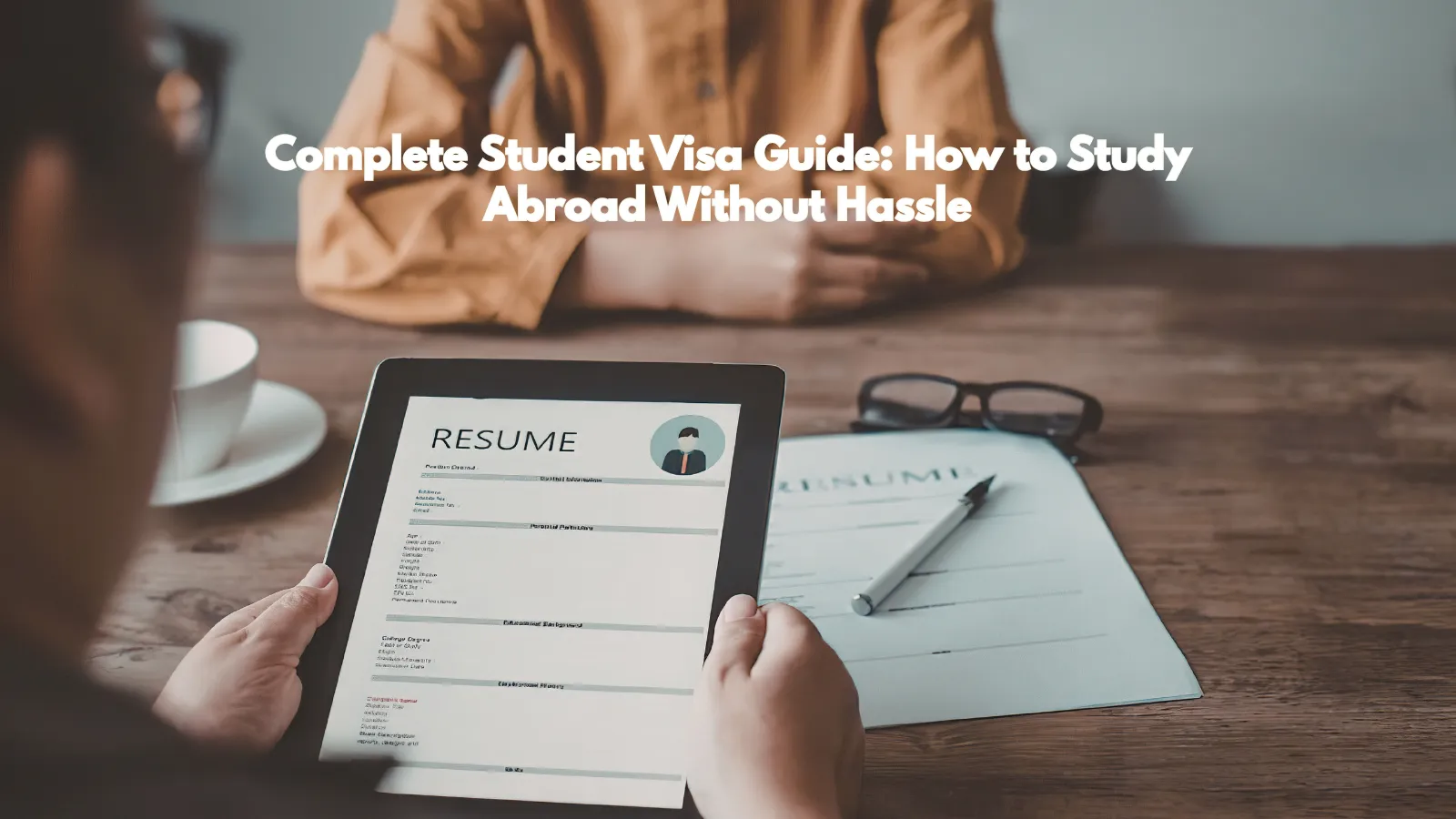
Complete Student Visa Guide: How to Study Abroad Without Hassle
IntroductionStudent Visa Guide is your first step to making your dream of studying abroad a reality. From the different types of visas to gathering all required documents and interview preparation, this guide walks you through everything you need to know in order for your journey to be smooth and stress-free.In the last few years, however, more […]
Introduction
Student Visa Guide is your first step to making your dream of studying abroad a reality. From the different types of visas to gathering all required documents and interview preparation, this guide walks you through everything you need to know in order for your journey to be smooth and stress-free.
In the last few years, however, more Indians than ever are taking the plunge overseas to study. In 2023, the US granted a total of 130,839 visas to Indian students, an increase of 14% over the previous year. It was a 54% increase year-on-year from June 2022, as the UK issued 142,848 sponsored study visas.
Canada has shown similar growth. Even so, foreign students do get visas refused at times for reasons like incomplete applications or lack of preparation. And that’s why it’s so key to understand the process, step by step.
Here, I am sharing some insights based on a conversation with Kainaaz Mistry, Lead Operations of Education Services at OneVasco, as she guides every individual who wishes to apply for a student visa for the US, UK, or Canada through the process, along with practical tips that can help increase their chances of approval.
Read more: https://travellerscoop.com/visa-renewal-guide-steps/
Can I work while studying abroad?
Perhaps the most common question that I get from students getting ready to study abroad is whether or not they are able 10 work while studying. This is a frequent question as many students wish to obtain practical experience, cover their living costs, and/or discover part-time job opportunities in a new nation.
My student visa guide states that whether or not you can work during your studies really depends on the country you choose to study in, as well as what type of student visa you are given, and sometimes even the level/type of course.
In some parts of the world, students can work during semesters part-time and only full-time in between, while in others, students have unique programs such as internships or co-op placements that are directly connected to their academic area.
According to My Student Visa Guide, these rules are important because breaking the conditions of your visa can have serious consequences and may even lead to cancellation of a student visa or prohibition from applying for a new one.
And not all work opportunities are created equal. There are structured options in certain countries (the US, UK, or Canada) that allow you to gain work experience while abiding by visa regulations. It will also help you plan for your finances, what work opportunities to take up, and how to get the most out of studying abroad without risking your visa.
Navigating the Student US Visa Process
The US offers three main types of student visas:
- M-1 Visa: for vocational or technical training.
- J-1 Visa: for cultural and educational exchange programs.
- F-1 Visa: for full-time academic degree programs.
Most Indian students apply for the F-1 Visa, which also allows Optional Practical Training (OPT) after graduation, allowing you to work in your field for up to 12 months. STEM graduates may extend this for an additional 2 years.
1. Determine Your Eligibility
Do I get an F-1 Visa and how, according to my Student Visa Guide:
- Be accepted by a SEVP-certified university: An F-1 Visa can only be granted to students attending an institution certified under the Student and Exchange Visitor Program (SEVP).
- Proof of financial stability: You need to show that you have enough funds to pay for tuition fees and living expenses while in the country. Bank statements, financial letters, or scholarship proofs are generally enough.
- Demonstrating strong ties to India: You must prove that you have a clear intent to return to India after your education. This is an important point, because visa officers want to be sure that your time in the US is temporary and solely for educational purposes.
Tempering these steps out, as discussed in this how to get a Student Visa guide, significantly elevates your odds of getting an easy stamp on your F-1 Visa.
2. Obtain Your I-20 Form
Once your university accepts you, they provide the Form I-20, which is a necessary document for your application for the F-1 Visa. My Student Visa Guide shows you what to do to obtain it:
- Pass details and academic records: Your university uses this to verify your identity and eligibility.
- Provide funding evidence: Prove you can support your studies and living expenses in the US.
- Store the Form I-20: This is one of the most important documents for your visa application, as well as proof of status when entering the US.
As per this Student Visa Guide, following these steps, one after another, will lead you to a smooth process of obtaining your I-20 and then applying for an F-1 Visa.
3. Complete the DS-160 Form
The Nonimmigrant Visa Application (DS-160) is a vital online form in which you enter in-depth information about yourself, your travel details, and your study plans. My Student Visa Guide provides the following instructions on how to do it properly:
- Be honest and specific: Describe your study plans, educational goals, and why you chose the US. The more accurate and thorough the answers are, the smoother the process.
- Upload a passport-size photo in accordance with US guidelines: Must comply with official standards. Skip casual selfies; the photo is a formal component of your application.
- Double-check submission information: It may seem simple, but small errors can lead to delays or complications down the line.
- Pay a US$160 visa fee (this is non-refundable): This fee needs to be paid online, and is required to process your DS-160 application.
The Student Visa Guide Tip: Following these tips ensures your DS-160 is complete, accurate, and ready for your F-1 Visa interview.
4. Pay Application Fee and IHS
And if you are submitting a student visa, you also need to be careful about the fees. Here’s what my Student Visa Guide tells me to do:
Pay the visa fee online: Everyone must go through this process to move forward with their visa application.
Paying the Immigration Healthcare Surcharge (IHS) – it covers medical insurance while you are outside your country.
Retain confirmation receipts: Secure confirmation receipts for the visa fee and IHS as you might require it during property application or on travel.
Completing all these steps is essential to ensure that you pay the correct amount of fees and don’t run into any issues in your visa application process.
5. Attend Your Visa Interview
So, according to the quite prepared student visa guide, your answers should be persuasive, clear, and honest. Your intentions are what the visa officer must know, and hence, this is all about communication.
- Do not talk really fast or stall too much, just speak clearly and confidently.
- Clarify your study goals, why you selected this course, and how ICT aligns with your career objectives.
- Say why you chose your university, perhaps because of its reputation, quality of teaching, or opportunities.
- Prepare to explain your financial plan, including who’s sponsoring your education or how you’ll cover expenses.
- Share your plans for after study, showing how you would like to use the education for career growth.
- Keep eye contact and a clear voice during the interview.
This means that you should not memorize your answer, but instead provide an honest and suitable reply.
UK Student Visa Process
The UK has different visa types, but most undergraduate and postgraduate students require the Student Visa.
How to Apply for a UK Student Visa
Determine Your Eligibility:
- According to this student visa guide, the initial part is verifying whether you fulfill all the eligibility requirements.
- You have to be 18 years or older (16–17-year-olds require parental consent).
- You will need a Confirmation of Acceptance for Studies (CAS) from a recognised UK body.
- You should meet the English language requirement (IELTS/TOEFL)
This requires you to demonstrate financial evidence that includes tuition fees, living costs, and the Immigration Health Surcharge (IHS)
Gather Essential Documents:
- To prevent delays, this student visa guide advises getting all documents in advance.
- Passport Valid for the entire duration of stay
- A CAS document with a reference number unique to the applicant.
- Academic certificates and transcripts.
- Bank statements and other proof of sponsorship.
- IHS payment confirmation.
Submit the Online Application:
- This student visa guide also states that accuracy is key when completing the application.
- Fill out the form on the UK Visas and Immigration site.
- Provide correct and honest information.
- Make sure to double-check every detail before putting in your form.
Pay the Application Fee and IHS:
- As noted in this student visa guide, the payment step is required.
- VISA application fee (depends on your type and duration of course).
- Pay for the Immigration Health Surcharge (IHS), which gives you access to healthcare in the UK.
Book and Attend a Biometrics Appointment:
- Identity verification is done through biometrics (as discussed in this student visa guide).
- Make an appointment at a specific visa centre.
- Submit fingerprints and a digital photograph.
- Keep your passport and appointment confirmation on hand.
Attend Visa Interview (If Required):
- It recommends preparing for an interview if you are called, according to this guide to student visas.
- Explain your study plans and choice of university.
- Explain your financial situation clearly.
- Talk about what you want to do after your studies.
Track Your Visa Status:
- The last step of this student visa guide is tracking your application.
- Be sure to use your reference number to track the status of your visa online.
- If you order during a peak season, be patient with shipping delays.
Following these steps from the student visa guide will ensure you are one step closer to a UK student visa the right way.
Conclusion
This may be overwhelming when it comes to student visa processes in the USA, UK, and Canada, but it can all be done with careful preparation and diligence. By following this student visa guide, Indian students will know how to meet eligibility criteria, what documents are needed, and the steps involved in the application process; they will become well-prepared for the interview as well, which can improve their chances of getting a visa approval.
Services, such as OneVasco or The Red Pen, simplify the process even more with expert guidance and advice. This guide can help you get on the right track to studying abroad and fulfill your academic career goals.
Read more: https://travellerscoop.com/apply-thailand-visa-india/
FAQs
1- What is the most common student visa for the USA?
The F-1 Visa is the most common for full-time degree students.
2- Do I need health insurance for a UK or Canadian student visa?
Yes, the UK requires the Immigration Health Surcharge (IHS), and Canada may require proof of medical coverage.
3- How early should I apply for a student visa?
Ideally, 3–6 months before your course start date to allow for processing and unforeseen delays.
4- Can I work while studying on a student visa?
Yes, with restrictions. F-1 Visa holders in the US can work on-campus and may apply for OPT after graduation. The UK and Canada also allow limited work hours for students.

Khushi Vaid
Senior Travel EditorI’m Khushi Vaid, a travel writer with over 2 years of experience creating destination guides, travel tips, and travel planning content. At Traveller Scoop, I write about destinations, travel trends, and practical advice to help readers explore the world with confidence.