Top Countries Launching New Visa Programs in 2026
Countries launching new visa programs in 2026 have completely changed how I plan my trips this year, and honestly, I did not expect this shift to happen so fast. Six months ago I was helping a reader plan a “work from Bali for winter” trip, and by the time she landed, three more countries had […]

Countries launching new visa programs in 2026 have completely changed how I plan my trips this year, and honestly, I did not expect this shift to happen so fast. Six months ago I was helping a reader plan a “work from Bali for winter” trip, and by the time she landed, three more countries had quietly opened brand-new visa doors.
That is the pace we are working with right now. If you have been putting off a long-stay trip because visas felt confusing, this is the year that confusion actually starts working in your favor.
I have spent the last few weeks going country by country, cross-checking income limits, stay durations, and application costs, so you don’t have to dig through twenty government portals yourself.
This guide covers exactly which nations are opening fresh visa routes in 2026, what they cost, who qualifies, and, because I know you’ll ask, how you can actually use this information to plan a real trip, not just read about one.
Why Are So Many Countries Launching New Visa Programs in 2026?
Governments are not doing this out of kindness. Post-pandemic tourism boards realised that long-stay visitors spend far more than a five-day tourist ever does, without taking a single local job.
A remote worker on a one-year visa pays rent, buys groceries, uses local gyms, and eats out three times a week for months; that is a completely different economy than a backpacker passing through for four nights.
Add to that the global shift toward remote work, and you get a wave of new visa programs designed specifically to pull in this spending power. Roughly 55 dedicated digital nomad-style visas now exist worldwide, and that number is expected to cross 60 before the year ends.
Asia-Pacific alone has produced more new visa launches between 2024 and 2026 than any other region, with Europe close behind through smaller, budget-friendly entrants.
This is the core reason behind the trend of countries launching new visa programs in 2026, it is a direct economic strategy, not an accident.
Full List: Countries Launching New Visa Programs in 2026
Here is the researched, numbers-first breakdown of the newest programs actually live this year.
1. Bulgaria: Digital Nomad Visa (Type D Long Stay)
Bulgaria officially opened its digital nomad visa route in January 2026, a year after joining the Schengen Area. It targets remote workers from outside the EU/EEA who already have a presence in nomad hubs like Bansko and Sofia. This is one of the newest and cheapest entry points into the Schengen zone for long-stay remote workers.
2. Sri Lanka: Digital Nomad Visa
After years of delays, Sri Lanka’s Department of Immigration and Emigration finally launched its digital nomad visa in February 2026. Applicants need roughly USD 2,000 in monthly income for the standard one-year visa, with a longer five-year option also available and renewable.
3. Slovenia: Digital Nomad Permit
Slovenia became one of Europe’s newest digital nomad destinations in late 2025, and its program is now in full effect through 2026. It is quickly becoming a quieter, more affordable alternative to Portugal or Spain for people who still want EU access.
4. Moldova: Budget Two-Year Visa
Moldova rolled out a digital nomad program in late 2025 with an income requirement of around USD 3,100 per month. What makes it stand out among countries launching new visa programs in 2026 is the two-year validity, longer than most European competitors offering similar income thresholds.
5. The Philippines: Remote Work Visa (Recently Signed)
The Philippines signed a new digital nomad visa framework, positioning itself alongside Sri Lanka as one of the newest entrants in the Asia-Pacific region for 2025–2026, following a broader regional trend of new visa programs opening across Southeast Asia.
6. South Korea: Workation Visa (Piloting Into 2026)
South Korea’s workation visa is still in pilot phase heading into 2026, with the income test tied to twice the national GNI per capita. Seoul remains the primary base for applicants, and the exact threshold shifts yearly, so checking directly with the embassy before applying is essential.
7. Nepal: Announced Digital Nomad Program
Nepal has announced a digital nomad visa program targeted for 2026, joining Thailand, Malaysia, Taiwan, and South Korea as part of Asia’s fast-catching-up nomad visa landscape.
Established Programs Worth Comparing Before You Choose
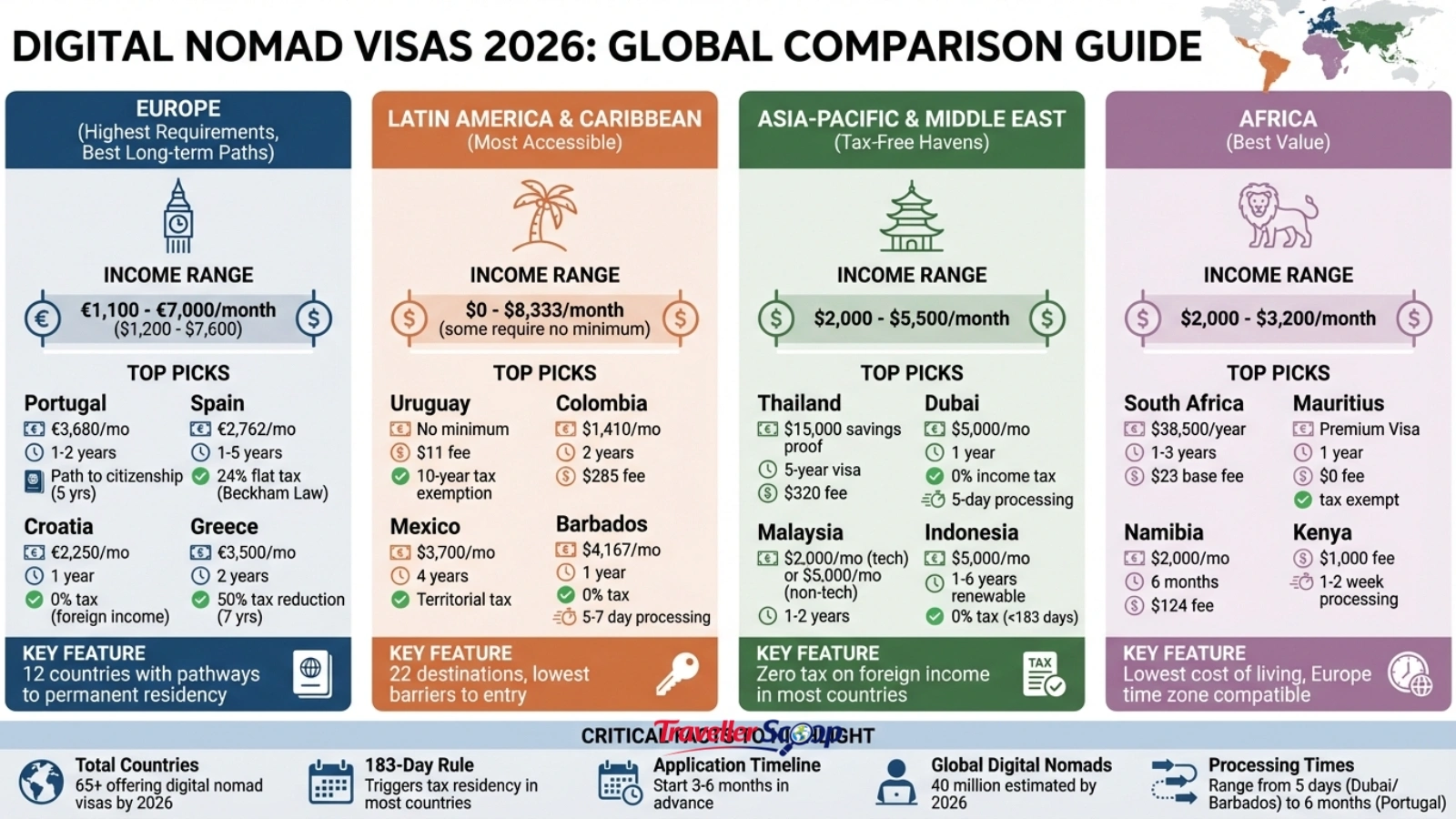
If the newest launches don’t fit your budget or timeline, some of the older, more refined programs are still worth it in 2026, especially since income limits have shifted slightly this year.
- Portugal (D8 Visa): Around €760/month minimum income, valid 2 years, renewable, with a path to permanent residency after 5 years.
- Spain: Requires roughly €2,334/month, valid up to 5 years, with a reduced 24% flat tax rate for the first five years instead of the standard rate.
- Greece: Needs about €3,500/month income, valid 1 year and renewable for two more, plus a 50% income tax reduction for the first seven years.
- Estonia: The original pioneer since 2020, requiring about €3,500/month, application fully online, visa fee around €80, and processing in 15–30 days.
- Croatia: Up to a one-year stay with roughly €2,300/month income required.
These aren’t new for 2026, but they remain the benchmark that every new digital nomad visa country is being compared against.
How Much Do These New Visa Programs Actually Cost?
Since this is the number every reader asks me first, here’s a quick comparison of monthly income thresholds across some of 2026’s newest programs:
| Country | Minimum Monthly Income Required | Visa Duration |
|---|---|---|
| Sri Lanka | ~USD 2,000 | 1 year (5-year option available) |
| Moldova | ~USD 3,100 | 2 years |
| Bulgaria | Varies by case | Long-Stay (Type D) Visa |
| Spain | ~€2,334 | Up to 5 years |
| Portugal | ~€760 | 2 years (Renewable) |
These thresholds change every year, sometimes more than once, so always verify the current figure with the official embassy or immigration portal before you apply.
Add Your HStep-by-Step: How to Apply for a New Country Visa Program in 2026eading Text Here
- Shortlist 2-3 countries based on your monthly income and how long you want to stay.
- Check the official government immigration site directly, not a blog, not a forum, for the current income threshold and required documents.
- Arrange proof of income, usually bank statements, employment contracts, or freelance invoices from the last 3-6 months.
- Get international health insurance that covers the full visa duration; almost every one of these programs requires it.
- Submit your application either online (Estonia, for example, is fully digital) or through the nearest embassy.
- Wait for processing, this ranges from 15 days (Estonia) to a few months for newer programs still building their systems.
If you want a country-by-country visual breakdown of income and processing time for your own upcoming trip, check our detailed digital nomad visa income calculator guide and our best countries for remote work in Asia post, both are updated for 2026 figures.
Which of These New Visa Programs Should You Actually Pick?
If you are chasing affordability first, Sri Lanka and Bulgaria currently offer the lowest entry barriers among countries launching new visa programs in 2026.
If EU access matters more to you long-term, Slovenia and Moldova are quietly becoming the smarter budget picks compared to Portugal or Spain, which now require higher income thresholds than a few years ago.
For readers who want a longer runway without reapplying constantly, Moldova’s two-year visa and Sri Lanka’s five-year option are the standout choices this year. I’d also recommend reading our complete guide to remote work visas by region if you’re still deciding between Europe, Asia, or Latin America.

Conclusion
Countries launching new visa programs in 2026 are reshaping how millions of remote workers and long-term travelers plan their next move, and the pace of new launches shows no sign of slowing down.
Whether you’re drawn to Sri Lanka’s low income bar, Moldova’s two-year runway, or Bulgaria’s fresh Schengen-adjacent route, the right move is always the same: verify the current numbers directly with the embassy before you commit because these thresholds shift often.
I’ll keep updating this guide every time a new country joins the list, so bookmark this page and check back before you book your next long-stay trip.
Whether you’re interested in Sri Lanka’s relatively affordable income requirement, Moldova’s two-year digital nomad visa, Bulgaria’s long-stay visa pathway within the European region, or other emerging destinations, there are now more choices available than ever before.
Each country offers different benefits, including varying income thresholds, visa durations, tax rules, healthcare requirements, and renewal options. Choosing the right destination depends not only on the cost of living but also on your work style, lifestyle preferences, and long-term goals.
However, one important thing to remember is that visa policies are constantly evolving. Governments regularly update eligibility criteria, minimum income requirements, application fees, documentation rules, processing times, and renewal conditions.
A country that offers one set of requirements today may revise them within a few months. That’s why it’s always essential to verify the latest information directly with the country’s official embassy or immigration authority before submitting an application, booking flights, or making relocation plans.
FAQs
How long does it usually take to get approved?
Processing time varies widely: Estonia's fully online system takes 15-30 days, while some of the newer 2026 programs, like Bulgaria and Sri Lanka, may take longer as their systems are still being refined.
Which countries are launching new visa programs in 2026?
Bulgaria, Sri Lanka, Slovenia, Moldova, and the Philippines are among the newest countries with active or newly signed visa programs in 2026, alongside Nepal and South Korea, which have programs announced or piloting this year.
What is the easiest new digital nomad visa to get in 2026?
Based on income requirements alone, Sri Lanka's visa (around USD 2,000/month) and Portugal's D8 visa (around €760/month) currently have the lowest financial bar among active programs.
How many countries offer digital nomad visas in 2026 total?
Dedicated digital nomad visa programs currently number around 55 worldwide, with that figure expected to pass 60 later in 2026 as more programs go live.
Do these new visa programs let me work a local job?
No. Nearly every digital nomad or remote-work visa program requires your income to come from outside the host country, you cannot take a local job on these visas.

Khushi Vaid
Senior Travel EditorI’m Khushi Vaid, a travel writer with over 2 years of experience creating destination guides, travel tips, and travel planning content. At Traveller Scoop, I write about destinations, travel trends, and practical advice to help readers explore the world with confidence.