
Middle East Flight Disruptions: Check Active Flights Now
Middle East flight disruptions have turned what were once smooth, predictable travel plans into a stressful nightmare for hundreds of thousands of passengers worldwide. If you’ve been searching “check active flights now” or wondering whether your airline is still flying to Dubai, Doha, Tel Aviv, or Riyadh, you’re not alone.I’m Khushi Vaid, travel writer at […]
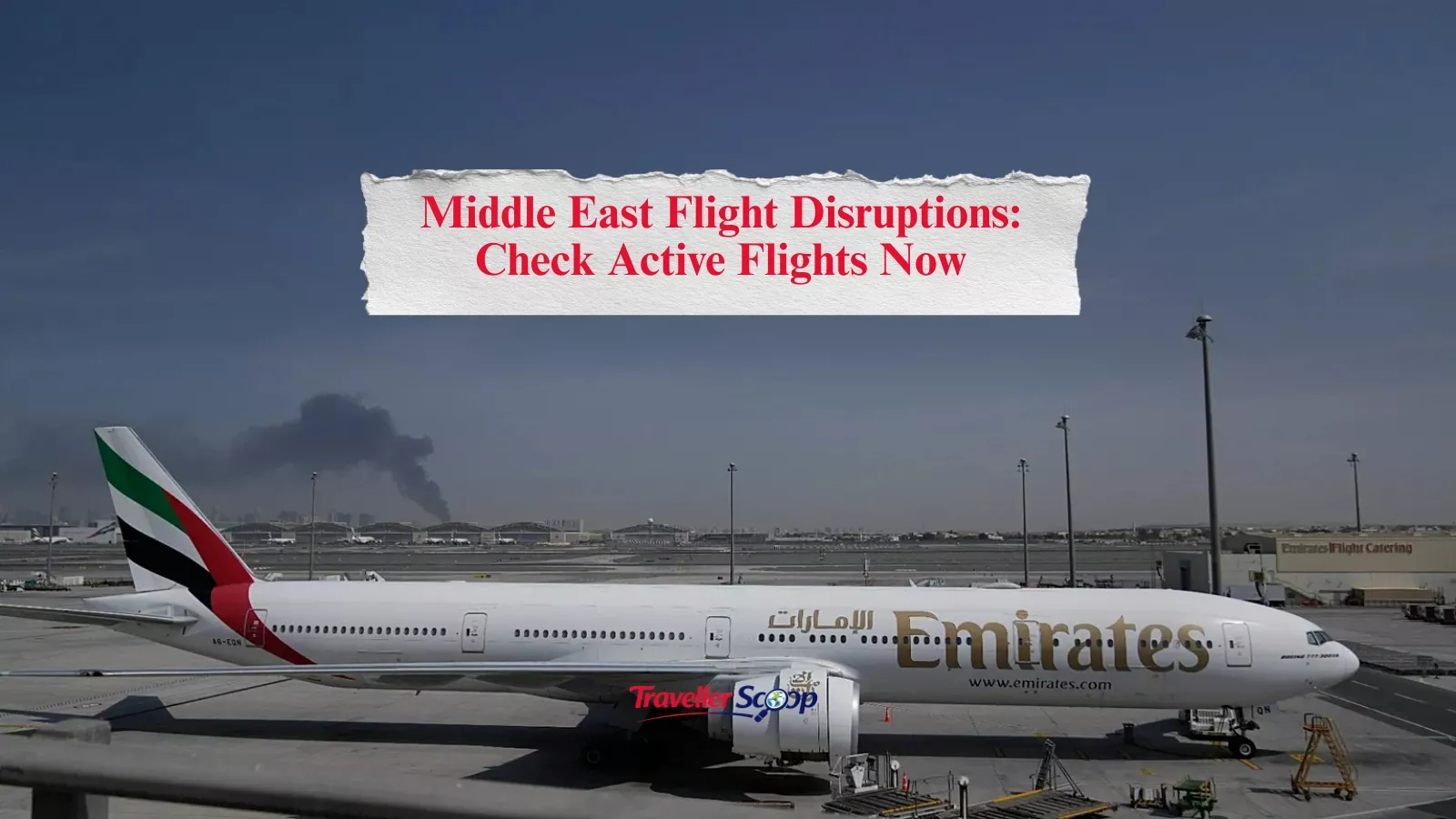
Middle East flight disruptions have turned what were once smooth, predictable travel plans into a stressful nightmare for hundreds of thousands of passengers worldwide. If you’ve been searching “check active flights now” or wondering whether your airline is still flying to Dubai, Doha, Tel Aviv, or Riyadh, you’re not alone.
I’m Khushi Vaid, travel writer at Traveller Scoop, and I’ve spent the last several days tracking every update, every cancellation notice, and every airline advisory so you don’t have to.
The Middle East flight disruptions that began in June 2026, following military escalations between Israel, Iran, and the United States, have created one of the most chaotic aviation crises the world has seen in years.
According to aviation tracker FlightAware, over 382 flight cancellations were recorded in a single day at the peak of the crisis. Major hubs like Dubai International, Doha’s Hamad International Airport, and Abu Dhabi International, which together handle over 250 million passengers annually, were either partially closed or severely disrupted.
In this article, I’ll walk you through everything: which airlines cancelled flights to the Middle East, which airspaces are still closed, how to check your active flight status right now, your passenger rights, and how to protect yourself the next time you fly through this region.
This is the complete, information on Middle East flight disruptions you’ve been looking for.
Why Are There Middle East Flight Disruptions Right Now?
The Middle East flight disruptions of 2026 were triggered by a series of military events that rapidly escalated across the region. Here’s a timeline of what happened:
- June 13, 2025: Israel launched large-scale airstrikes targeting Iranian nuclear sites, missile factories, and military leadership. Iranian airspace shut down immediately and without notice, stranding dozens of flights mid-route.
- June 23, 2025: The United States confirmed direct military involvement, conducting strikes on three Iranian nuclear and military facilities, further widening the conflict.
- June 24, 2025: Iran retaliated by launching a missile attack on the Al Udeid Air Base in Qatar — the largest US military base in the Middle East, temporarily forcing Doha’s Hamad International Airport to shut down.
- Late June 2025: A ceasefire was announced between Israel and Iran, but airlines continued cancellations through the end of June, citing safety concerns and unpredictable airspace access.
- February–March 2026: A second wave of Middle East flight disruptions hit as the conflict re-escalated, stranding passengers at airports in Beirut, Newcastle, and across Europe.
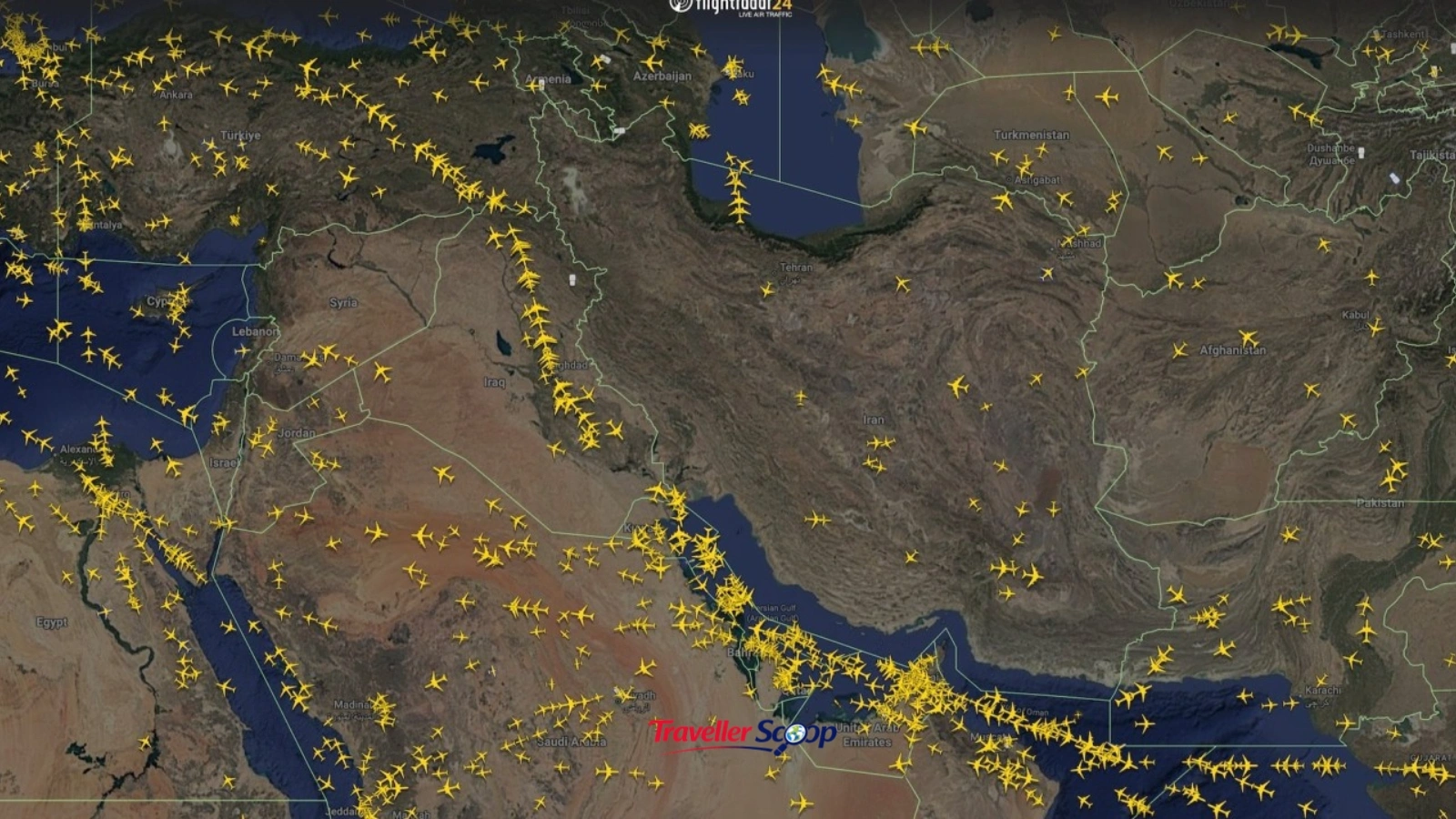
The Middle East airspace closure of 2026 affected Iran, Iraq, Israel, and Jordan simultaneously, a combination that shut down one of the world’s busiest aviation corridors connecting Europe to Asia.
Flights that normally saved hours by flying over these countries were forced to reroute via Turkey, Central Asia, or even Africa, adding 2 to 5 extra hours to journey times.
Which Airlines Cancelled Flights to the Middle East?
This is the most urgent question for travelers. Here is a comprehensive breakdown of airlines cancelling flights to the Middle East and their specific route suspensions:
The flight cancellations the Israel-Iran conflict caused were truly global in scale. An Emirates flight from Manchester diverted mid-air to Istanbul, while a Flydubai jet flying from Belgrade was rerouted to Yerevan, Armenia.
| Airline | Routes Affected | Status / Suspension Period |
|---|---|---|
| Emirates | Baghdad, Basra (Iraq), Iran | Suspended through June 30, 2025 |
| Etihad Airways | Tel Aviv | 2 flights cancelled, 4 flights delayed |
| flydubai | Amman, Beirut, Damascus, Iran, Israel | Full suspension |
| Air India | Entire Middle East network | Services halted during peak conflict |
| IndiGo | Dubai, Doha, Abu Dhabi, other Gulf routes | Flights cancelled or diverted |
| British Airways | Dubai, Doha, Riyadh | Weekend cancellations |
| Air France / KLM | Dubai, Doha, Riyadh | Flights cancelled; rebooking offered |
| Lufthansa | Multiple Middle East destinations | Operations suspended |
| Singapore Airlines | Gulf routes | Flights diverted |
| Gulf Air | Jordan routes | Suspension extended through June 27 |
| Aegean Airlines | Tel Aviv, Beirut, Dubai, Abu Dhabi | Phased suspensions (Tel Aviv until March 20) |
| airBaltic | Tel Aviv | Cancelled through March 28 |
| United Airlines | Various Middle East routes | Suspended |
| Delta Air Lines | Various Middle East routes | Suspended |
| American Airlines | Selected Middle East routes | Partial suspension |
Air India halted its entire Middle East service, which also affected its long-haul routes to Europe and the US East Coast as they transit through Gulf hubs.
How to Check Active Flight Status Right Now (Middle East)
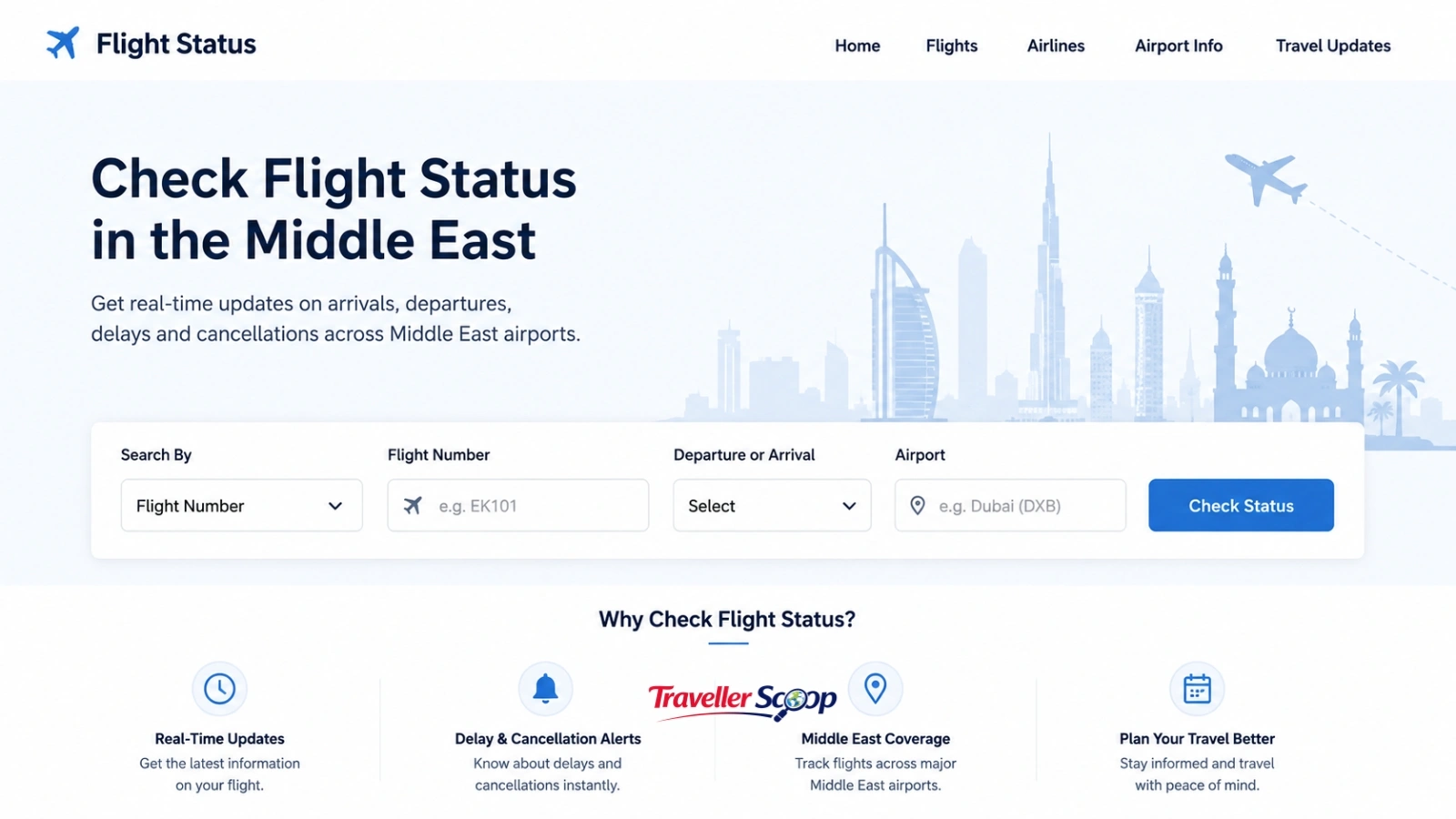
If you’re flying to or through the Middle East, here’s exactly how to check your flight status in real time:
Step 1: Use Live Flight Trackers
The best tools to check active Middle East flight disruptions in real time are:
- Flightradar24 (flightradar24.com): Shows live aircraft positions, diversions, and airspace restrictions. During the June 2025 crisis, Flightradar24 data showed a mass exodus of commercial aircraft from Israeli, Iranian, and Iraqi airspace within hours of the strikes beginning.
- FlightAware (flightaware.com): Tracks cancellations globally. At peak disruption, FlightAware recorded 382 cancellations in a single day linked to Middle East airspace closures.
- OAG Flight Status: Good for checking specific flight numbers across airlines.
Step 2: Check Your Airline's Official Website
Always check your airline’s official website or app before heading to the airport. Airlines issue real-time travel waivers and rebooking options on their websites first. Most airlines affected by flight cancellations in the Israel-Iran conflict offered fee-free rebooking during the disruption period
Step 3: Sign Up for Flight Alerts
Use Google Flights or your airline’s app to set up SMS and email alerts for your specific flight. This is critical during Middle East airspace closure 2026 situations when things change by the hour.
Step 4: Contact Your Travel Insurance Provider
If your flight is cancelled due to Middle East flight disruptions caused by military conflict, standard travel insurance may not cover “force majeure” events. However, some premium policies do cover conflict-related cancellations. Call your provider immediately.
Your Passenger Rights During Middle East Flight Disruptions
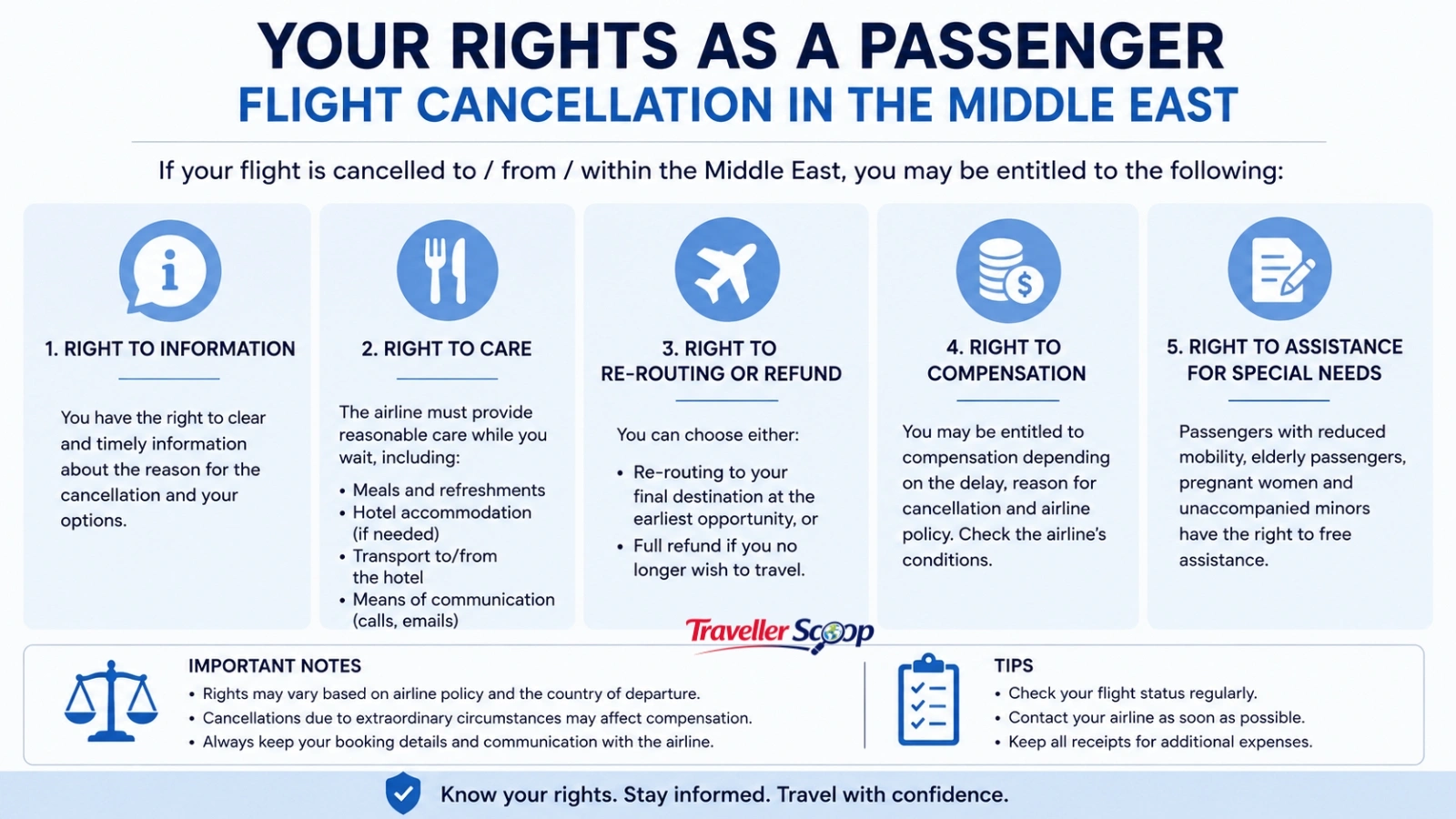
Knowing your rights is just as important as knowing your flight status. Here’s what you’re entitled to when airlines cancel flights to the Middle East and affect your journey:
Under EU Regulation EC 261/2004 (Applies to EU Flights)
- If your flight departs from an EU airport or arrives on an EU carrier, you may be entitled to compensation of €250 to €600, depending on flight distance, but only if the cancellation was not due to “extraordinary circumstances” like military conflict.
- Airlines have argued that Middle East flight disruptions caused by the Israel-Iran conflict qualify as extraordinary circumstances, meaning compensation may not apply, but you are still entitled to a full refund or alternative routing.
Under Indian DGCA Rules (Applies to Indian Travelers)
- Airlines must offer a full refund or a rebooking on an alternative flight at no extra charge.
- If you’re stranded at a non-hub airport due to the Middle East airspace closure of 2026, the airline must provide meals and accommodation during waits over 2 hours for domestic or 4 hours for international flights.
What Airlines MUST Do for All Passengers
Regardless of nationality or route, all airlines cancelling flights to the Middle East are required to do the following:
- Inform passengers of the cancellation as early as possible.
- Offer a full refund or free rebooking.
- Issue travel waivers allowing passengers to change travel dates without penalty fees.
Many airlines issued such waivers automatically during the June 2026 Middle East flight disruptions. If yours did not, contact customer support and specifically ask for a “travel waiver due to conflict disruption.”
Which Airports Were Most Affected?
The Middle East flight disruptions hit certain airports far harder than others. Here’s a breakdown:
Ben Gurion Airport, Tel Aviv (Israel)
Shut down until further notice following the Israeli airstrikes on Iran on June 13, 2025. This is Israel’s only major international airport, so the closure effectively cut off air access to the country entirely.
Tehran Imam Khomeini International Airport (Iran)
Iranian authorities confirmed the complete closure of Iranian airspace immediately after the Israeli strikes. This disrupted not just flights to Iran but all flights that cross Iranian airspace, primarily Europe-to-Asia routes.
Baghdad International Airport (Iraq)
Iraq closed all airports and suspended all traffic early on June 13, 2025. This was particularly damaging because eastern Iraq near the Iranian border handles dozens of daily flights between Europe and South/East Asia.
Hamad International Airport, Doha (Qatar)
Temporarily halted operations on June 23, 2026, following Iran’s missile strike on the nearby Al Udeid Air Base. Doha is one of the world’s busiest transit hubs, and its closure cascaded disruptions globally. Airspace reopened within hours, but airlines continued cancellations for safety reasons.
Dubai International Airport (UAE)
While Dubai’s airport itself did not close, Emirates and flydubai suspended or rerouted numerous flights. Emirates flights were rerouted using paths “well distanced from conflict areas,” adding significant travel time for passengers.
How to Travel Smart During Middle East Flight Disruptions
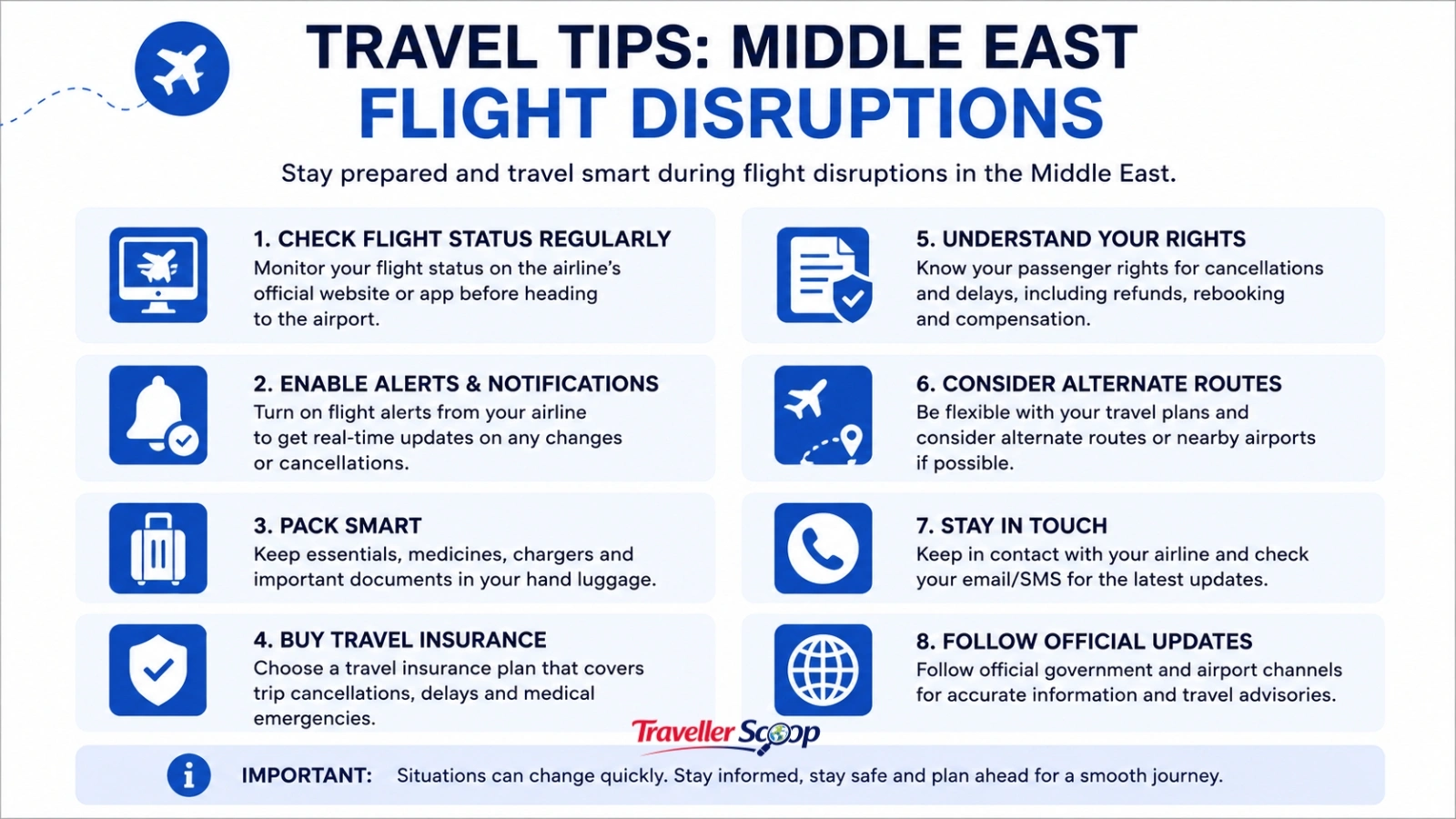
As a travel writer who has covered multiple aviation crises, here are my top practical tips for navigating Middle East flight disruptions:
- Book Refundable Fares During Uncertain Periods: Non-refundable tickets save money in normal times but become expensive liabilities during a crisis. When the Middle East airspace closure 2025 situation develops, refundable fares give you the flexibility to cancel without loss.
- Choose Connecting Hubs Wisely During the 2025 crisis, travelers connecting through Istanbul, Amman (when open), and Colombo faced fewer disruptions than those routed through Dubai or Doha. Keep an eye on which hubs are geographically safer from conflict zones.
- Always Have a Direct Airline Contact: Don’t rely only on third-party booking platforms during Israel-Iran conflict situations. Have your airline’s direct customer service number saved. Third-party platforms like MakeMyTrip or Booking.com are often slower to issue waivers than airlines themselves.
- Monitor EASA and DGCA Advisories: Europe’s aviation safety agency EASA, and India’s DGCA both issued advisories telling airlines to avoid Middle East airspace during the conflict. Checking their websites gives you an early warning before airlines make public announcements.
- Travel Insurance With Conflict Coverage: Standard travel insurance does not cover flight disruptions caused by military conflict. Look specifically for policies that include “war risk coverage” or “political disruption coverage” if you travel frequently to or through the Middle East.
Impact on Indian Travelers: What You Need to Know
Indian travelers are among the most affected by Middle East flight disruptions because the following:
- Millions of Indian workers are employed in the UAE, Saudi Arabia, Qatar, Kuwait, and Bahrain. Flight cancellations strand them away from home or from jobs.
- India’s busiest international routes, Mumbai–Dubai, Delhi–Dubai, and Kochi–Abu Dhabi, pass through Gulf hubs that saw severe disruptions.
- Air India halted its entire Middle East service during the peak conflict period, affecting not just Gulf-bound travelers but also passengers transiting to Europe and the US East Coast via Middle Eastern hubs.
- IndiGo, which operates hundreds of weekly flights to the Gulf, also cancelled and diverted multiple routes.
The Indian Ministry of External Affairs activated emergency helplines during the February 2026 wave of Middle East flight disruptions. If you are stranded, contact the nearest Indian Embassy or Consulate in the region.
Conclusion
Middle East flight disruptions are not just headline news; they are a real crisis affecting real people: migrant workers trying to return home, families separated across continents, and tourists stuck at airports with no answers.
As I’ve laid out in this guide, the scale of flight cancellations caused by the Israel-Iran conflict in 2025 and 2026 is unprecedented in recent aviation history, with hundreds of flights cancelled daily and major hubs like Dubai, Doha, and Tel Aviv either shutting down or severely limiting operations.
The most important things to remember: check your flight status before you leave for the airport, know your passenger rights, carry travel insurance that covers conflict-related disruptions, and stay updated through official airline channels and live flight trackers like Flightradar24.
At Traveller Scoop, we’ll continue updating our coverage on travel disruption in the Middle East in 2026 and beyond. Bookmark this page, share it with anyone you know who’s flying through the region, and reach out in the comments if you have questions. Safe travels, because no matter how disrupted the skies get, the world is still worth exploring.
FAQs
How long will Middle East flight disruptions last?
Middle East flight disruptions linked to the Israel-Iran conflict lasted approximately 12 days during the June 2026 wave. The February 2026 wave was still evolving as of late February 2026. There is no fixed timeline; airlines say more cancellations remain possible.
Are flights to Dubai running normally right now?
Flight status changes daily during periods of Middle East flight disruptions. Emirates resumed most Dubai routes after the June 2025 ceasefire but cancelled flights to Iraq and Iran through June 30. Always check Emirates.com or Flightradar24 before you travel.
Which airlines are still flying to Middle East during disruptions?
Some airlines adapted by rerouting rather than cancelling. Singapore Airlines, Korean Air, and some Gulf carriers found alternate paths avoiding conflict zones. Check each airline's website for current route status.
Will I get a refund if my flight to Middle East is cancelled?
Yes, airlines cancelling flights to the Middle East are required to offer either a full refund or free rebooking. Contact your airline's customer service and specifically request a "travel waiver."
Is it safe to travel to the Middle East right now?
Safety depends on the specific country and the current conflict status. Countries like UAE, Saudi Arabia, and Qatar remain largely operational during travel disruption Middle East 2025 situations, though flights may be delayed or rerouted. Always check your government's travel advisory.

Khushi Vaid
Senior Travel EditorI’m Khushi Vaid, a travel writer with over 2 years of experience creating destination guides, travel tips, and travel planning content. At Traveller Scoop, I write about destinations, travel trends, and practical advice to help readers explore the world with confidence.