How to Prepare for a Visa Interview Confidently?
Prepare for a visa interview is something I always take seriously whenever I plan to apply for a U.S. visa. Understanding how to prepare for a visa interview helped me feel more confident and less nervous during the entire process.The visa interview is more than a cordial chat with an immigration officer; it will be the […]
Prepare for a visa interview is something I always take seriously whenever I plan to apply for a U.S. visa. Understanding how to prepare for a visa interview helped me feel more confident and less nervous during the entire process.
The visa interview is more than a cordial chat with an immigration officer; it will be the most important step in determining whether a consular officer believes I would really come to study or not.
So here I am, sharing all in simple words based on my learning from the visa interview. I will tell you the main points that helped me to get clear on how to present myself, what documents are important, answers you can provide, and how you should perform yourself at the time of the interview. These outlined steps are vital if someone is planning to study abroad, but more so in America.
Visa interviews last only for a few minutes (sometimes even less), but these minutes are extremely critical. This is why I work to focus on preparation, clarity, and honesty. Here are the top five things on how to solve the visa interview process in a simplified manner.
Read more: https://travellerscoop.com/complete-student-visa-guide-study-abroad
What should I focus on while preparing for a visa interview?
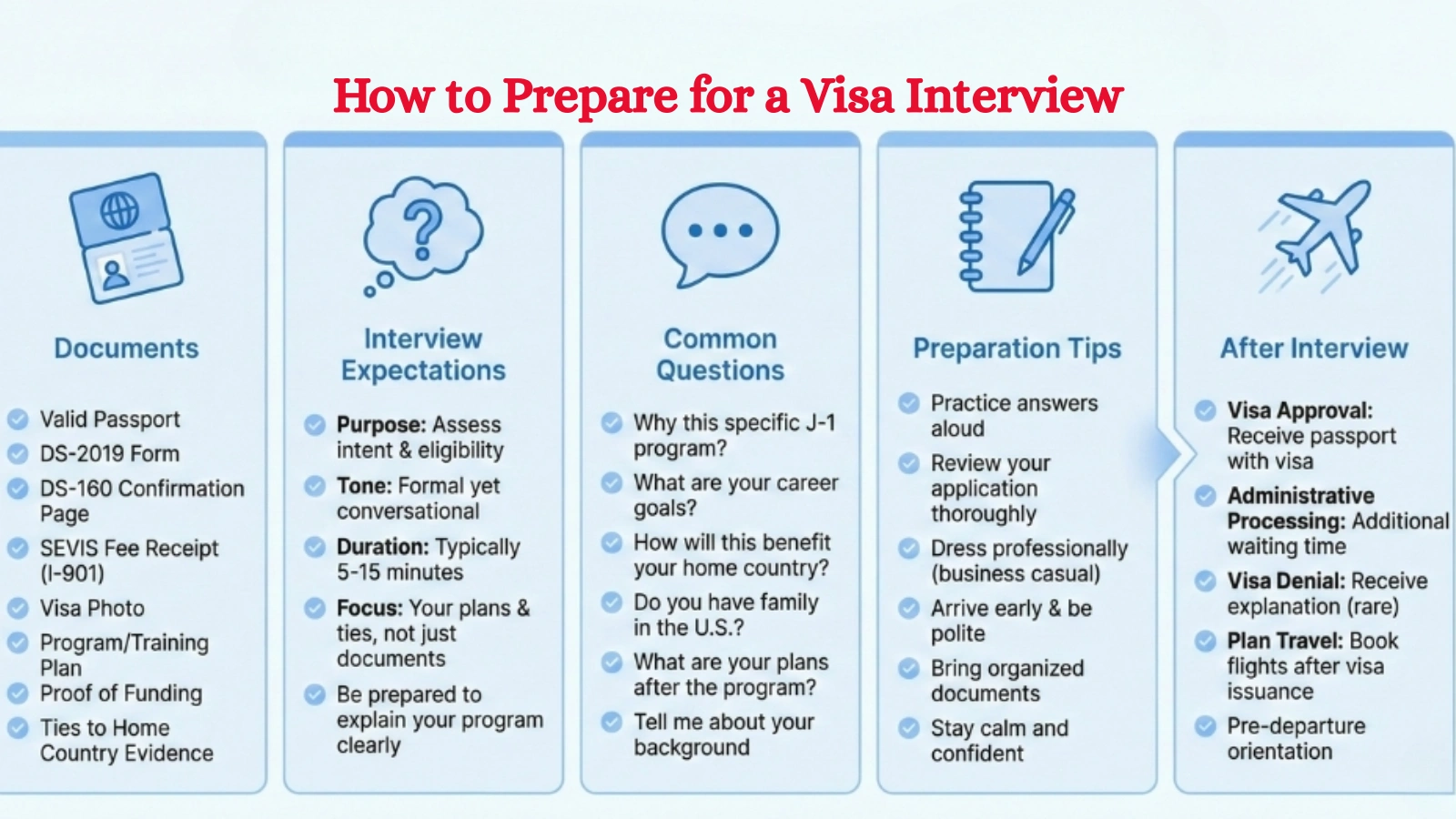
When I think about Prepare for a visa interview, the first thing I understand is that success does not come from memorizing answers; it comes from focusing on the right areas. Knowing how to prepare for a visa interview helped me realize that the interview is more about clarity, confidence, and honesty rather than long explanations or perfect English.
While preparing, I focus on a few important things that truly make a difference in the final decision. These are the areas that help me stay confident and ready for any question the consular officer may ask.
1. Clear Purpose of Travel
The most important thing I focus on is my purpose of travel. I always make sure I can clearly explain why I want to study in the United States.
When I prepare for a visa interview, I keep my answer simple:
- What I want to study
- Why I chose that course
- Why I chose the U.S. instead of my home country
- How this course will help my future career
If I am not clear about my purpose, it becomes difficult to convince the officer. That is why I always connect my studies with my future goals in my home country.
2. Strong Home Country Ties
Another major focus while learning how to prepare for a visa interview is proving strong ties to my home country. I must show that I have strong reasons to return after completing my studies.
I prepare to explain the following:
- My family connections
- Future job opportunities in my country
- Career plans after graduation
- Any financial or personal responsibilities
These ties help the officer understand that I do not plan to stay permanently in the U.S. but will return after completing my education.
3. Honest and Simple Communication
While preparing for a visa interview, I focus on speaking honestly and simply. I avoid memorized answers because they can sound unnatural.
Instead, I practice:
- Speaking in clear and basic English
- Giving short and direct answers
- Staying calm and natural during conversation
- Answering only what is asked
I also remind myself that the interview is short, so I should not give long or unnecessary explanations. Keeping answers simple makes communication easier and more effective.
How can I increase my chances of success in a visa interview?
I can increase my chances of success in a visa interview by preparing clear answers, showing strong ties to my home country, and confidently explaining my study plans and future career goals.
1. Strong Ties to Your Home Country and Clear Future Responsibility
The most crucial component of preparing for a visa interview is demonstrating my ties to my home country. Knowing how to prepare for a visa interview made me understand that the main concern of the visa officer is that I will come back to my home country after finishing my studies in America. This is the reason, and I always try to define my tie to my home country in the simplest and most honest way.
By ties, I mean all the substantive reasons that bind me to inhabiting my home country and returning post-education. Such ties are extremely vital as they correlate to trust and reaffirm my intent is only temporary study, not immigration.
Family Connections:
I tend to point toward my familial ties as a key reason for longing to travel back. During the interviews, I am quite blunt and honest. I have an emotional and sometimes financial dependence on my family. Family ties are one of the most powerful obligations and a devotion to my homeland.
Career Research in Home Country:
I remember being like, “When preparing the visa (my future job prospects, as you might expect).” My education in the U.S. will help me get better job opportunities when I go back,” I explain. I relate my course to the industries and job roles one gets back home, thereby linking it clearly to a career.
Business or Financial Plans:
I also note details of any future business ventures, investments, or financial obligations. This could include tangible property, bank investments, or any other financial commitments that would require my return home.
Dependents and Responsibilities:
If I have dependents like parents, a wife, or children, I state clearly what their support will be while I am presently abroad. This shows that I have serious responsibilities in my home country, and I can’t stay outside the country permanently.
The conviction that you will return home after your studies:
I prepared a very quick, succinct explanation that I am primarily an educator, not an immigrant or looking to stay long-term in the U.S. I concentrate on the future after obtaining my degree.
Emphasizing these aspects makes me more confident in my visa interview. Having strong connections with my home country allows me to present a case that I am well-established at home, and therefore, it increases my chances of obtaining approval from the officer.
2. Speak Clearly in English, Stay Natural, and Be Brief
Part of preparing for a visa interview is to have solid communication skills. Noting that communication is key when learning how to prepare for a visa interview, if I communicate clearly and confidently, the consular officer will likely not evaluate my interview based on an awkward experience. As the interview is generally in English, I always remind myself to speak clearly and confidently and use simple language.
Being effective in communication does not require complex vocabulary or long sentences. Clearly and honestly saying what I need to say in a few minutes.
Practice Basic English Conversation.
I practice basic English speaking while preparing for a visa interview. But I talk about simple things like my studies, family, and plans. All of that makes me much more comfortable than when the real interview.
I am not worried about perfection; however, I am concerned with fluency. My English is quite simple, but I always make certain that I can explain my answers without hesitation.
Avoid Memorized or Rehearsed Answers:
Avoid Memorized Answers. Avoiding memorized answers is a very important part of how to prepare for a visa interview. I never try to memorize whole speeches, because they just sound weird.
I concentrate on the comprehensibility of my answers instead. That way, I can respond in a natural way based on whatever question you have asked. Remember that sincere and impulsive responses are impressive in interviews when compared to rehearsed dialogues.
Speak for Myself Only:
One thing that I keep on reminding myself during the visa interview is to speak for myself only. In my case, I do not have parents or relatives who can explain anything on my behalf.
The consular officer wants to know what I think, that I am thinking about how I will proceed. This proves, above all, independence and responsibility—qualities that are extremely important during the interview.
Keep Answers Short and Clear:
Another important point in preparing for a visa interview is being succinct. I know that the interview time is very short, and so I tend to respond quickly without long or unnecessary explanations.
I am focused on responding with direct answers that clearly answer the question. If the officer requires more information, they will inquire.
Stay Calm, Confident, and Respectful:
The focus will always be on remaining calm at such a moment. I breathe deeply and speak slowly and clearly because nervousness can impact communication.
Some habits I always follow:
- I answer only what is asked
- I cut out unnecessary or unrelated details
- I stay confident and relaxed
- I never interrupt the officer
Often, you think that the best way to communicate is to speak more. This gives me the confidence to be more prepared for the visa interview.
3. Understand Your Course, University, and Career Plan Clearly
A strong study plan and clarifying a future career goal are some of the strongest parts of preparing for a visa interview. The first tip that I learned about preparing for a visa interview is to take a deep breath and not be daunted, because primarily the consular officer wants to see if you are indeed a student who plans an academic future.
This is precisely why I always prepare an elaborate answer for my course, choice of university, and long-term career in advance. It becomes hard to convince the officer that I am not an immigrant or intending a permanent move and only want to study without clear language on that front.
Line of Reason Why I Should Pick My Course Clearly:
In a visa interview, I always prep him on why he chose that course. I ensure that I can articulate both my interests in the topic and its compatibility with my academic background.
Nor do I give some random vague reasons, you being so new. Instead, I relate my decision for the course to future career direction—combining it with my skill set and personal interest.
Reason for Choosing a Particular University:
The other essential component of How to Prepare for a Visa Interview is detailing why you opted for an institution in the USA.
I do research all the way to formulate a proper answer:
- University ranking and reputation
- Course structure and subjects offered
- Faculty and learning environment
- Career support and opportunities
It helps me demonstrate that I have researched my decision, rather than doing something at random.
I try to relate the studies to my future career plan. This will be a very pivotal point during the interview.
For example:
- If I do business, I specify what it will be with management or entrepreneurship.
- If I read IT, then I show how I am going to work in the tech space
- When you write about healthcare, justify how it helps develop a medical career in your country.
- It is this connection that demonstrates I have a target behind why I am even earning an education.
Future Job Plans Upon Returning Home:
An essential part of preparing for a visa interview is explaining how I would do my job after my studies.
I always prepare a concise answer to the following:
- What field do I want to work in
- Which Type of Positions am I Targeting
- What I’m Going to Do With My Degree and How It Will Help Me Get Those Opportunities
- I hate answers such as “I want a good job. Rather, I set out achievable targets for my career.
Realistic and Honest Career Vision:
In preparing for a visa interview, I realize that answers that sound unrealistic can decrease credibility. Which is exactly why I always try to keep my career plan pragmatic and realistic.
I make sure my answers show the following:
- Logical career growth
- A well-linked study to a career
- Define plans on returning to my home country and building my future.
I feel confident at the visa interview level when I prepare my study plan and career goals. Having a defined academic path shows that I’m an earnest student and will likely help me more to prepare for a visa interview.
Read more: https://travellerscoop.com/visa-renewal-guide-steps
4. Proper Documents, Global Differences, and Smart Preparation
Documentation is very crucial for preparing for a visa interview. Prepare for a Visa Interview — I realize that my documentation is not only paper but also evidence of my study intent and financial status, as well as my academic qualifications. And that is why I always try to be structured and very clear about everything.
Given the constricted timeframe of a consular officer, my documents are summarized, complete, and directly connected to my visa application.
Keep All Important Documents Ready:
Whenever I have a visa interview somewhere, even to this day, I carry all required documents in the exact order. These usually include:
- Admission letter from the university
- Financial evidence (bank statements or sponsorship details)
- Records related to academia, such as marksheets and certificates.
- Passport and visa application forms
I never have too many papers in my bag because having a pile of documents is rather confusing than helpful.
Make Documents Easy to Understand:
Simplicity and comprehensiveness in my documents are hallmarks of how to prepare for a visa interview. I put them in a folder so I can quickly access what the officer requests.
I can kindly unravel what each document means because I know them to their core, and if the need may arise, an explanation will be a formality
Prepare for Various Levels of Validation:
I am aware that all applicants are not created equal. People, depending on where they come from or from what country situation they are coming to, may be asked questions.
While I cannot control this, I can make my answers and documents strong, clear, and honest to prepare better. This enables me to manage issues calmly.
One of the critical lessons in Prepare for a Visa Interview is that lengthy written explanations are eggshells. Most interviewers do not have time to read through detailed papers while sitting across from the officer during the interview.
That’s why I always try to verbally explain things clearly and straightforwardly rather than relying too much on documents.
Stay Confident and Organized:
- I feel confident that preparation has got me ready for the interview. I always
- Keep my documents neatly arranged
- Know what each paper represents
- Do not furnish any extra or irrelevant documents
- This means always being ready and prepared to provide financial and academic proof.
So when I manage my documents properly, preparing for a visa interview becomes way easier.
5. Positive Attitude, Confidence, and Respectful Behavior
Last but not least, an equally important part of visa interview preparation is attitude. How to prepare for a visa interview: I learned that my behaviors and mindset are as important as the answers and documents. My positive attitude helps me to create a good first impression and be confident, respectful, and serious about the goals.
In the interview, I always have in mind that the way I present myself can make a huge impression on how far they will see me as an officer.
Stay Calm, Polite, and Respectful:
For instance, when preparing for a visa interview, my strategy starts the moment I walk into the room: calmness and respect. I found the need to be courteous and clear with my answer.
When I am nervous, I avoid showing my feelings. My ability to remain calm helps me to think clearly and respond more effectively.
Never argue with a consular officer:
Staying polite with everyone has to be an indispensable part of how to prepare for a visa interview. Even if I feel confused or stressed, I never argue or disagree with the consular officer aggressively.
I realize all too well that they are just doing their job, and speaking with respect always adds a favorable touch.
Handle Rejection Positively:
I am not too emotionally or negatively affected if my visa is denied. For example, I am polite and ask for the following:
- The reason for refusal
- What documents should I improve
- How could I do better next time
It demonstrates maturity, a sense of responsibility, and an intention to do better.
Follow Good Interview Behavior Habits:
When preparing for a visa interview, I am always conscious of some basic behavior rules:
- Stay positive and confident throughout
- Do not argue or take any defensive stance
- Be mindful of listening before answering any question
- Be polite in each response
The very collection of these micro-habits helps me to show up as a more professional and trustworthy individual.
Importance of First Impression:
As I know, first impressions are everything in preparing for a visa interview. If a few cops in the first thirty seconds didn’t like how I sounded, acted, or looked, forget about getting anywhere.
That is why I focus on the following:
- Confident body language
- Clear eye contact
- Calm and polite responses
- Positive energy from the beginning
Yes, having a pleasant state of mind is not going to guarantee you the visa, but it surely increases my odds of leaving a good impression.
Conclusion
Preparing for a visa interview can feel stressful, but once I understand the process, it becomes much easier. Learning how to prepare for a visa interview helped me focus on the most important things: clear communication, strong ties to my home country, proper documentation, and a confident attitude.
I always remind myself that the main purpose of the interview is to prove that I am a genuine student with clear academic goals and a strong intention to return home after completing my studies. When I prepare honestly and simply, I feel more confident and ready.
Read more: https://travellerscoop.com/schengen-visa-guide-first-time-travelers/
FAQs
1- How long does a visa interview usually take?
Most visa interviews are very short, usually 2–5 minutes. That is why clear and quick answers are important.
2- Do I need perfect English for the interview?
No, perfect English is not required. You only need to communicate clearly and confidently.
3- What is the most important factor in a visa interview?
Showing strong ties to your home country and clear study intentions is the most important factor.
4- Can I bring my parents to the interview?
No, you should go alone. The interview is only for the applicant.

Khushi Vaid
Senior Travel EditorI’m Khushi Vaid, a travel writer with over 2 years of experience creating destination guides, travel tips, and travel planning content. At Traveller Scoop, I write about destinations, travel trends, and practical advice to help readers explore the world with confidence.