
Schengen Visa vs UK Visa: The Ultimate Guide to Which Is Easier for Indian Travellers
Schengen Visa vs UK Visa is one of the most important comparisons to make when planning an international holiday from India. Both visas allow Indian passport holders to visit popular European destinations, but their application processes, fees, supporting documents, and travel permissions are different.If you are planning your first trip abroad, understanding these differences can […]
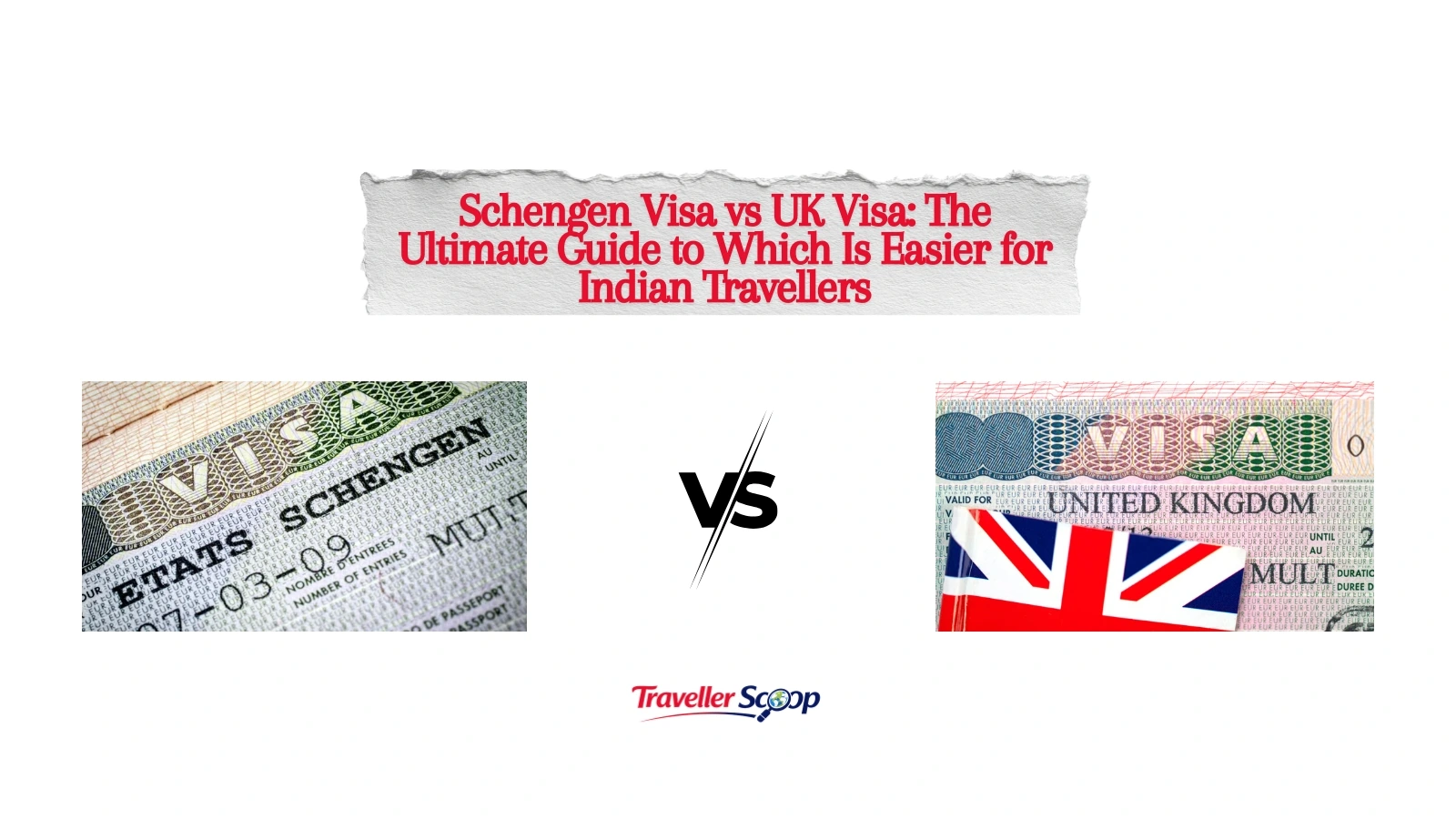
Schengen Visa vs UK Visa is one of the most important comparisons to make when planning an international holiday from India. Both visas allow Indian passport holders to visit popular European destinations, but their application processes, fees, supporting documents, and travel permissions are different.
If you are planning your first trip abroad, understanding these differences can help you choose the right visa and avoid unnecessary expenses.
When I compare the two options for Indian travelers, I look beyond the application fee. I also consider financial proof, employment documents, travel history, processing time, and the purpose of the trip.
A visa that appears easier on paper may not necessarily be easier for someone with an irregular income or limited travel history.
The Schengen visa is useful for visiting participating European countries on one trip, while the UK Standard Visitor visa is designed for eligible short visits to the United Kingdom. Neither visa guarantees approval, and neither is automatically easier for every Indian applicant.
In this guide, I will explain the main differences, the latest published standard fees, document requirements, and practical steps you can take to prepare a stronger application. I will also explain which option may suit first-time travellers, salaried employees, self-employed applicants, and people visiting family.
Which Visa Is Easier to Get for Indian Travellers?
There is no universal answer to whether the Schengen visa or UK visa is easier. The result depends on your personal circumstances, financial situation, travel purpose and the evidence you provide.
The Schengen visa is generally more convenient when your holiday includes several participating European countries. You submit an application through the country responsible for your main destination, rather than applying separately for every country on your itinerary.
The UK visa is more straightforward geographically if you intend to visit only England, Scotland, Wales or Northern Ireland. However, its application is assessed under UK immigration rules, and you must demonstrate that you qualify for a visit.
Here is my practical comparison:
The European Commission publishes the standard Schengen fee and processing rules, while the UK government publishes the visitor fee and processing standards.
Factor | Schengen Visa | UK Standard Visitor Visa |
|---|---|---|
Main purpose | Short visits to participating Schengen countries | Short visits to the UK |
Standard adult fee | €90 | ₹17,771 for a six-month visa |
Standard processing time | Usually 15 calendar days | Usually 3 weeks |
Travel medical insurance | Required for a standard short-stay application | Not generally mandatory for the visa application |
Multiple destinations | Can cover several Schengen countries | Does not provide entry to Schengen countries |
Financial evidence | Required | Required to demonstrate eligibility, where relevant |
Approval guarantee | No guarantee of approval | No guarantee of approval |
My recommendation is to choose based on your actual itinerary and the strength of your documents, not on social media claims that one embassy is always easier.
What Is the Difference Between a Schengen Visa and a UK Visa?
The most important difference is geographical coverage. Although the United Kingdom is in Europe geographically, it is not part of the Schengen Area.
A short-stay Schengen visa generally permits visits of up to 90 days in any 180-day period across the participating countries, subject to the conditions printed on the visa. It is commonly used for tourism, family visits and certain business trips.
The UK Standard Visitor visa usually allows eligible visitors to stay for up to six months per visit. However, the immigration officer can still examine whether the visitor meets the applicable entry requirements.
A UK Standard Visitor visa covers visits to the United Kingdom under the permitted visitor activities. It does not automatically grant entry to France, Italy, Spain, or other Schengen countries.
For example, imagine you are planning a 10-day trip from India.
Trip A: Paris, Amsterdam and Rome. A Schengen visa may cover the trip, provided you apply through the correct country and meet all entry conditions.
Trip B: London, Oxford and Edinburgh. A UK Standard Visitor visa may be suitable for the trip.
Trip C: London and Paris. You will generally need to meet the entry requirements for both the UK and the Schengen Area.
This distinction matters because a visa for one area should never be assumed to provide access to another. Check the official rules for every country on your itinerary before booking non-refundable travel.
What documents do Indian travellers need for a Schengen visa?
The Schengen application requires evidence that you are a genuine short-term visitor, have sufficient financial means, understand your travel arrangements, and intend to leave the Schengen Area before your permitted stay ends.
The exact checklist varies by destination country and individual circumstances, but the usual supporting documents include:
Schengen visa document checklist
A valid passport meeting the applicable validity requirements.
A completed visa application form and compliant photograph.
Flight itinerary or appropriate travel reservation details.
Hotel bookings or evidence of accommodation.
A day-by-day itinerary explaining the destinations you intend to visit.
Recent bank statements and evidence of sufficient funds.
Employment documents, salary slips, or business and income evidence, as relevant.
Proof of ties to India and reasons for returning, where applicable.
Travel medical insurance meeting Schengen requirements.
Any additional documents requested by the relevant consulate.
One detail I would not overlook is the itinerary. If you are visiting three countries, your accommodation bookings and travel dates should tell a consistent story.
An itinerary showing five nights in France but accommodation booked for seven nights in Italy may prompt questions if you cannot explain the discrepancy.
For more information about potential refusal concerns, read TravellerScoop’s guide to Schengen countries rejecting Indian visa applications.
The European Commission specifically lists a valid passport, application form, photograph, medical insurance, evidence of the visit’s purpose, financial means, accommodation, and intention to return.
Fingerprints are generally collected, subject to applicable exemptions.You should also apply through the correct consulate. If you visit several Schengen countries, apply through the country where you will spend the longest time.
If the stays are equal, apply through the country you will visit first.

What documents are required for a UK visitor visa from India?
The UK Standard Visitor visa has its own application process. Applicants complete an online form and attend a visa application centre appointment to prove their identity and provide the required documents.
For an ordinary tourism or family visit, prepare the following documents as relevant to your circumstances:
A valid passport or travel document covering your stay.
Your intended travel dates and accommodation details.
An explanation of your planned activities in the UK.
Evidence of your income, savings and ability to pay for the trip.
Employment confirmation, salary slips, or business documents where applicable.
Information about who will fund the trip if another person is paying.
Supporting evidence of your personal and financial circumstances in India.
Details of relevant travel history, if requested.
Certified translations for documents that are not in English or Welsh.
The UK government may also request employer details, information about family members in the UK, or other evidence depending on the applicant’s circumstances.
For instance, if your parents are funding your holiday, explain this clearly and provide appropriate evidence of their financial support. If you are employed, your documents should accurately reflect your income, leave dates and employment status.
The aim is not to submit the largest possible pile of paperwork. It is to provide relevant, consistent evidence that supports the information in your application.
Official application resource: Apply for a UK Standard Visitor visa on GOV.UK.
Which visa has a higher approval chance for Indian applicants?
This is where I would be especially careful about making broad claims.
There is no reliable universal rule saying that an Indian applicant is more likely to receive a Schengen visa than a UK visitor visa, or vice versa. Approval depends on the individual application and the applicable immigration rules.
The European Commission reported that Indian nationals submitted 1,108,239 Schengen short-stay visa applications in 2024. Across all nationalities, the worldwide refusal rate that year was 14.8%. These are historical statistics, not a prediction of the outcome for a particular Indian applicant.
A fair comparison of approval chances would require comparable official refusal statistics for the same period, visa category and applicant population. Without that, declaring one visa easier based on a single percentage can be misleading.
In my view, the more useful question is whether your application clearly demonstrates the following:
A genuine purpose of travel: Your plans should match the visa category.
Sufficient funds: Your financial evidence should reasonably support the proposed trip.
Consistent documents: Application details, bookings, employment records and supporting evidence should agree.
Credible travel plans: Your intended duration and accommodation should make sense.
Reasons to return: Your circumstances should support your stated plan to leave at the end of the visit.
Accurate information: Never hide relevant facts or submit false documents.
A first-time international traveller is not automatically ineligible simply because their passport contains few or no previous visas. Likewise, a traveller with several stamps is not guaranteed approval.
The practical lesson is simple: build a truthful application around your circumstances instead of relying on internet claims about which embassy is more generous.
What are the most common visa application mistakes?
Even a well-planned holiday can become stressful if the application contains avoidable errors. These are the issues I would check before submitting either application.
1. Applying through the wrong authority
For a multi-country Schengen trip, the main-destination rule matters. Do not simply apply through the country with the earliest appointment if it is not the correct consulate for your itinerary.
2. Showing unexplained financial activity
A bank balance should make sense in the context of your income and circumstances. Avoid treating a sudden, unexplained deposit as a substitute for credible financial evidence.
3. Submitting inconsistent bookings
Check the dates on your flight reservations, accommodation bookings, leave approval and itinerary. Correct any discrepancies before submission.
4. Ignoring the purpose of the trip
A tourist application should clearly explain the proposed holiday.
If you are visiting family, attending a permitted business meeting, or travelling for another reason, use the appropriate category and provide relevant evidence.
5. Applying it too late
A delayed appointment or additional document request can affect your travel plans. Start early enough to manage uncertainty.
6. Trusting guaranteed-approval agents
No agent can legitimately guarantee a visa decision. You are responsible for ensuring that the application and supporting documents are truthful and accurate.
For additional practical advice, you can also read TravellerScoop’s visa renewal guide, which covers processing considerations and preparation.
Conclusion
After comparing the fees, documentation, processing timelines and travel opportunities, my conclusion is that the right visa is the one that matches your destination and your circumstances.
If you want to explore Paris, Rome, Amsterdam or other participating European destinations on the same trip, the Schengen route may be more practical. If your plans revolve around London, Edinburgh or visiting family in Britain, the UK Standard Visitor visa is the relevant option.
The key takeaway from my Schengen Visa vs UK Visa research is that neither application should be treated as an easy formality. Both require accurate information, sensible financial planning and evidence that supports your genuine travel purpose.
Before applying, confirm the latest rules through the European Commission’s Schengen visa guidance and the official UK visitor visa guidance. That is the safest starting point for planning your international trip.
FAQs
How long does a Schengen visa take compared with a UK visa?
Schengen applications normally take 15 days and may take up to 45 days in certain cases. A UK Standard Visitor visa decision usually takes around 3 weeks after identity verification and submission of documents. Actual timelines can vary.
Is Schengen Visa vs UK Visa easier for Indians in 2026?
Neither is automatically easier for all Indian applicants. The decision depends on your circumstances, financial evidence, purpose of travel and the requirements of the relevant immigration authority.
Can Indians use a Schengen visa to enter the UK?
No. A standard Schengen visa does not automatically permit entry to the United Kingdom. Indian passport holders should check the UK government's visa requirements separately.
Can I visit multiple countries with a Schengen visa?
Yes, a valid Schengen short-stay visa can generally be used to visit participating Schengen countries, subject to its validity, number of entries and other conditions. You must also follow the 90-days-in-any-180-days limit.
Which visa is cheaper for Indian tourists?
The standard adult Schengen short-stay visa fee is €90, while the UK Standard Visitor visa fee is £135. The final cost in rupees depends on the applicable conversion and additional charges. Compare the total cost before deciding.

Khushi Vaid
Senior Travel EditorI’m Khushi Vaid, a travel writer with over 2 years of experience creating destination guides, travel tips, and travel planning content. At Traveller Scoop, I write about destinations, travel trends, and practical advice to help readers explore the world with confidence.