
Japan Visa for Indians 2026: A Powerful Guide to an Exciting Yet Tricky Application Process
Japan Visa for Indians is one topic I did not expect to obsess over this much, but here we are. When I started planning my own Tokyo-Kyoto trip earlier this year, I assumed the Japan Visa for Indians process would be a quick formality, like most of the other Asian visas I have applied for.I […]
Japan Visa for Indians is one topic I did not expect to obsess over this much, but here we are. When I started planning my own Tokyo-Kyoto trip earlier this year, I assumed the Japan Visa for Indians process would be a quick formality, like most of the other Asian visas I have applied for.
I was wrong. The Japan visa for Indians 2026 process has changed quite a bit, new appointment rules, a wider eVisa rollout, and a fee revision that most blogs online still haven’t updated.
So I decided to research it properly, go through the official VFS and embassy pages myself, and write the Japan Visa for Indians guide I wish existed when I started. If you are confused about the Japan tourist visa for Indians, the Japan visa fees for Indians, or whether the new Japan eVisa for Indians actually works the way influencers claim, this article covers it all, A to Z, with real numbers.
Let’s be clear about one thing first: India does not have a visa-free or visa-on-arrival arrangement with Japan. So no matter how many times you see “Japan visa on arrival for Indians” trending in a Facebook group, it is not real.
Every Indian passport holder needs a valid visa before flying to Japan, and that is exactly why understanding the Japan Visa for Indians process properly, before you book flights, saves you from last-minute panic.
What Is a Japan Visa for Indians and Why Do You Need One?
A Japan visa for Indians is an official authorization issued by the Japanese government (through the Embassy of Japan or its consulates) that allows an Indian citizen to legally enter Japan for a defined purpose, tourism, business, study, or a family visit, within a specific time limit.
Since Japan does not offer visa-on-arrival or e-Gate entry to Indian passport holders, applying for the Japan Visa for Indians in advance is compulsory, not optional.
In my experience, most first-time applicants confuse “Japan tourist visa for Indians” with the kind of instant e-visa you get for countries like Sri Lanka or Kenya. Japan’s system is more structured.
Even though a digital version now exists (I’ll explain the Japan eVisa for Indians shortly), you still go through document verification, either online or at a VFS centre, before you’re cleared.
Types of Japan Visa for Indians You Can Apply For in 2026
Before applying for the Japan Visa for Indians 2026, you need to identify the correct visa category, because the wrong choice is one of the most common reasons applications get delayed.
- Single-Entry Tourist Visa: The most common Japan tourist visa for Indians, valid for one visit, usually allowing a stay of up to 90 days.
- Multiple-Entry Visa: Useful if you plan to visit Japan more than once within the visa validity, popular among frequent business travelers and those with relatives in Japan.
- Transit Visa: Needed only if you leave the airport transit area during a layover; if you stay airside, it isn’t required.
- Business Visa: For short-term meetings, conferences, or market visits without taking up local employment.
- Student/Long-Term Visa: For admissions, requiring an enrolment certificate and a No Objection Certificate (NOC) from your institution, processed through the traditional sticker route rather than the eVisa.
For nearly everyone reading this, the Japan tourist visa for Indians (single-entry) is the relevant one, and that’s the category this Japan Visa for Indians guide focuses on.
Japan eVisa for Indians: The Biggest Change of 2026
This is the part that genuinely surprised me during my research. The Japan eVisa for Indians, first introduced for short-term tourism in 2024–2025, has been expanded through 2026. It allows eligible Indian applicants to apply for a single-entry tourist visa without receiving a physical sticker in their passport, instead, you get a digital “visa issuance notice” that you show at check-in and immigration.
Here’s what I want every reader to understand clearly: the Japan eVisa for Indians is not a fully online, no-paperwork system like an ESTA. Depending on your jurisdiction, you may still need to submit documents at a VFS Japan Visa Application Centre, and the embassy digitally issues the approval afterward instead of stamping your passport.
So while the phrase “eVisa” sounds instant, treat the Japan eVisa for Indians the same way you’d treat any standard Japan tourist visa for Indians in terms of preparation time and documentation.
If you’re someone who also travels to nearby countries, it’s worth comparing how Japan’s process differs, I found the Taiwan visa for Indians noticeably faster in some respects, which shows how much visa policy varies even within Asia.
Japan Visa Fees for Indians in 2026: The Real Numbers
Japan visa fees for Indians were revised from April 1, 2026, and a lot of older articles online are still quoting outdated figures. Based on the most recent, verified update, here’s the actual Japan Visa for Indians fee structure:
| Fee Component | Amount (INR) |
|---|---|
| Single-Entry Visa (Embassy Fee) | ₹500 |
| Multiple-Entry Visa (Embassy Fee) | ₹500 |
| Transit Visa | ₹50 |
| VFS Global Service Charge | ~₹800 |
| Optional Courier/Delivery Service | ~₹550 |
| Estimated Total (most applicants) | ₹1,300 – ₹1,850 |
A few important notes on Japan visa fees for Indians that I learned the hard way from other applicants’ experiences shared online: all charges at the embassy/consulate window must typically be paid in cash in INR, and the VFS service fee is separate from the government fee, so don’t be shocked when the final receipt is higher than the ₹500 figure most people quote casually.
If your Japan Visa for Indians application is rejected, the government fee is generally non-refundable, which is another reason to get your documentation right the first time.
Documents Required for Japan Tourist Visa for Indians
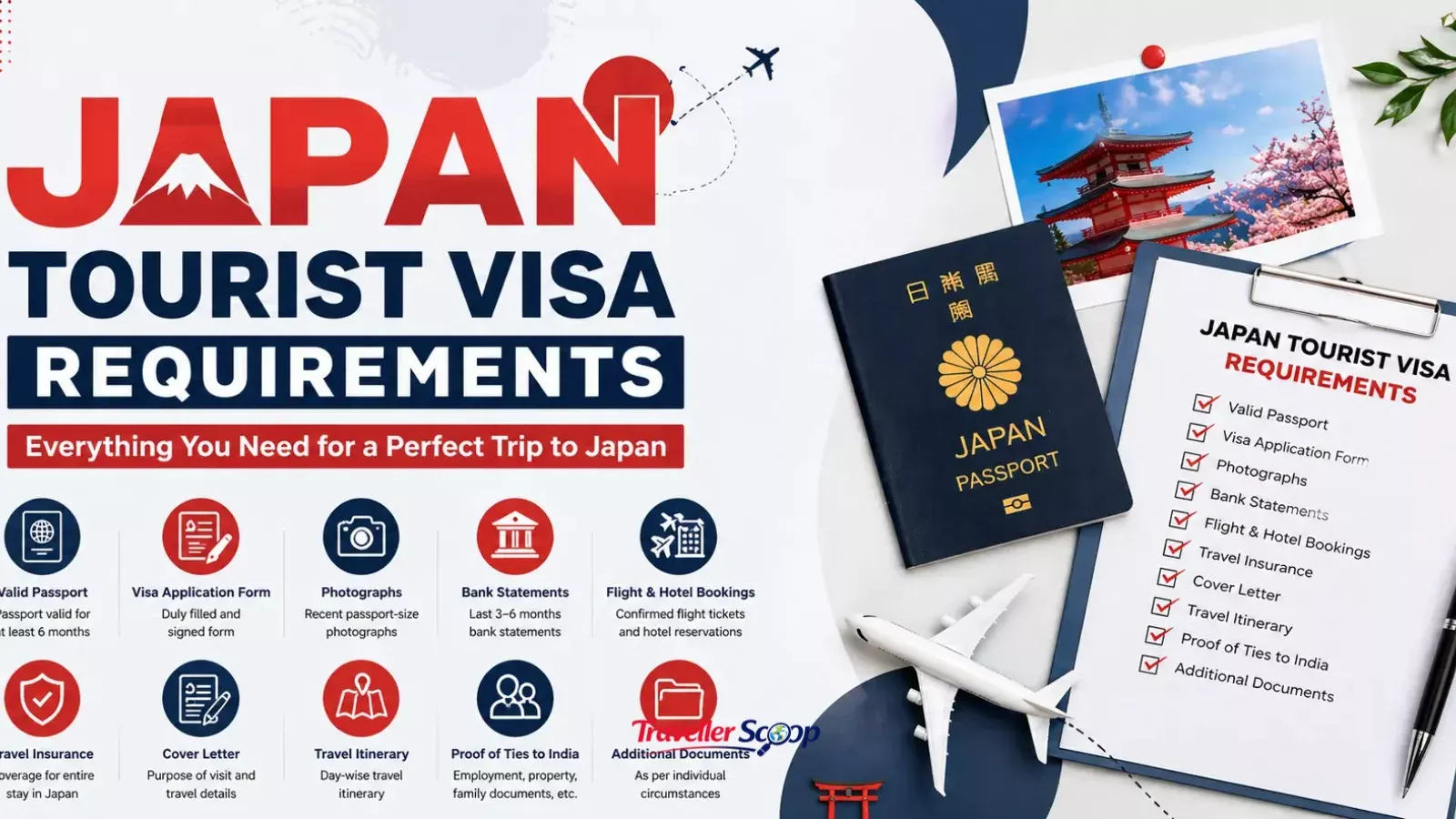
This is where most Japan visa applications for Indians either sail through or get stuck. Based on the current VFS Japan checklist, here’s what you need to prepare:
- Valid passport with at least six months’ validity and a minimum of two blank pages.
- Passport-size photograph, Japan is strict here; it must be 4.5cm x 4.5cm, plain white background, and taken within the last six months.
- Completed and signed visa application form, the city-specific form downloaded from the VFS portal.
- Confirmed flight itinerary (return ticket reservation, not necessarily a paid ticket).
- Hotel booking confirmation or an invitation letter if staying with someone in Japan.
- Day-wise travel itinerary (a “Schedule of Stay” document, which Japan is particular about compared to other countries).
- Bank statements for the last three to six months, along with your latest Income Tax Return (ITR).
- Employment proof, an NOC from your employer, or a GST certificate/business proof if self-employed.
- Travel insurance (recommended, and mandatory for some categories).
- Copy of any valid Schengen, US, UK, or Australian visa, if you hold one, it can support your Japan Visa for Indians application significantly.
On the financial proof front, there’s no fixed legally mandated amount, but based on multiple verified sources and my own cross-checking, maintaining somewhere between ₹1.5 lakh and ₹2 lakh in visible bank balance is a safe benchmark for a short tourist trip under the Japan Visa for Indians category.
If you’re a student applying separately, make sure to also check requirements around enrolment certificates, this is closer to how the South Korea visa fees for Indian applicants’ documentation works, where academic proof plays a bigger role than for standard tourist categories.
Step-by-Step Process to Apply for Japan Visa for Indians 2026
Once your documents are ready, the actual Japan visa application process for Indians looks like this:
- Confirm your category: single-entry tourist, multiple-entry, or eVisa eligibility, based on your city of residence.
- Book a VFS appointment is mandatory in several cities now (more on this below), so don’t assume you can walk in.
- Fill the visa application form carefully; your signature must match your passport signature exactly, which sounds trivial but has caused rejections.
- Submit documents at the nearest VFS Japan Visa Application Centre on your appointment date.
- Pay the applicable Japan visa fees for Indians at the counter (government fee + VFS service charge).
- Track your application using the reference number VFS provides.
- Collect your passport or receive your digital visa issuance notice, depending on whether you were processed under the eVisa or traditional sticker route.
Throughout this process, small errors are surprisingly common. If you’ve never applied for an international visa before, I’d also recommend reading up on how to apply for a visa without a travel history, since many Japan visa first-timers worry unnecessarily about this exact issue.
Japan Visa Processing Time for Indians
This is one of the more reassuring parts of the Japan Visa for Indians process. Compared to countries where you wait months, Japan is relatively fast:
- Japan eVisa for Indians: typically 3–5 working days
- Traditional sticker visa: typically 5–10 working days
- Some applicants with complete documentation have reported approvals in as little as 48 hours, though this isn’t guaranteed
- Japan’s Ministry of Foreign Affairs states the standard baseline is around five working days from the day after submission
However, I’d strongly advise applying at least three to four weeks before your travel date, and ideally four to eight weeks if you’re travelling during peak seasons, cherry blossom season in March-April, Japan’s Golden Week holidays, summer vacations, or the autumn foliage months, when Japan visa for Indians applications spike and processing can slow down.
VFS Centres and the New 2026 Appointment Rules
Here’s an update that genuinely changes how you should plan your Japan visa application for Indians. Starting March 2, 2026, walk-in submissions were officially discontinued in Chennai, Hyderabad, Kochi, and Puducherry. If you live in or around these cities, you must now book your appointment through the VFS Global Japan-India portal in advance; there is no workaround.
This shift happened because centers like Chennai and Hyderabad were previously seeing wait times of over three hours due to unpredictable walk-in crowds. The new appointment-based system reportedly caps submissions at around 600 files per day at major centers to keep things manageable.
Indian applicants can currently access VFS Japan centres across roughly a dozen cities nationwide, with the Embassy of Japan based in New Delhi and consulates generally in Mumbai, Kolkata, Chennai, and Bengaluru.
My honest tip: even in cities where walk-ins are technically still allowed, book an appointment anyway. It removes one layer of uncertainty from an already document-heavy Japan visa process for Indians.
Common Mistakes That Get a Japan Visa for Indians Rejected
Japan actually has a fairly high visa approval rate for Indian applicants, but rejections do happen, and almost always for avoidable reasons:
- Mismatched signatures between the application form and passport.
- Vague or inconsistent day-wise itinerary, Japan’s “Schedule of Stay” format expects real detail, not a rough plan.
- Insufficient or unclear financial proof, especially when bank statements show large, unexplained deposits right before applying.
- Incorrect photo specifications, the 4.5cm x 4.5cm rule is strict, and studios unfamiliar with Japan’s format often get it wrong.
- Missing employer NOC or unclear self-employment proof.
- Applying in the wrong category, like submitting a tourist application when the real purpose is short-term business.
If your broader travel plans also involve Europe, it’s worth reading about why so many Schengen countries are rejecting Indian visa applications lately, several of the same documentation gaps apply, and understanding one process genuinely helps with the other.
My Honest Take After Researching the Japan Visa for Indians Process
Having gone through embassy pages, VFS notifications, and real applicant experiences to put this Japan Visa for Indians guide together, my personal opinion is this: Japan has made real efforts in 2026 to modernize the process; the digital eVisa option, revised and genuinely affordable fees, and a more organized appointment system are all steps in the right direction. But “easier” doesn’t mean “casual.”
The Japan Visa for Indians process still rewards applicants who prepare a clean, detailed, well-documented file over those who rush it a week before their flight.
If there’s one thing I’d tell a friend applying for the Japan tourist visa for Indians for the first time, it’s this: build your itinerary properly, keep your bank statements clean and explainable, and book your VFS appointment the moment your travel dates are firm.
And before your final interview or document check, it genuinely helps to know how to prepare for a visa interview confidently, even though Japan rarely conducts a formal interview for standard tourist cases, the same calm, organised mindset applies.
Conclusion
The Japan Visa for Indians in 2026 is, honestly, more approachable than most people assume affordable fees, a growing digital eVisa option, and a clearer appointment system are all working in travellers’ favour.
But the process still demands attention to detail, from your 4.5cm photo to your day-by-day Schedule of Stay. If you treat your Japan Visa for Indian applications the way I’ve laid out in this guide, organised documents, realistic timelines, and the correct visa category, you’re setting yourself up for a smooth approval and, more importantly, a stress-free start to your Japan trip.
Safe travels, and I hope this Japan Visa for Indians guide saves you the confusion it took me a while to sort through myself.
FAQs
Which Indian cities require mandatory VFS appointments for the Japan visa?
Since March 2, 2026, Chennai, Hyderabad, Kochi, and Puducherry require mandatory appointments, with walk-in submissions discontinued in these centres for the Japan Visa for Indians.
Do Indians need a visa to travel to Japan in 2026?
Yes. There is no visa-on-arrival or visa-free entry for Indian passport holders. Every Indian citizen must obtain a Japan Visa for Indians before travelling, regardless of trip length.
What is the current Japan visa fee for Indians?
As of the 2026 revision, the Japan visa fees for Indians are ₹500 for both single-entry and multiple-entry visas, and ₹50 for a transit visa. VFS service charges of approximately ₹800 apply separately.
How long does the Japan tourist visa for Indians take to process?
The Japan eVisa for Indians typically takes 3–5 working days, while the traditional sticker visa takes 5–10 working days. Applying three to four weeks in advance is recommended.
Is the Japan eVisa for Indians completely online?
Not entirely. While approval and issuance happen digitally for eligible applicants, most Indian residents still need to submit documents through a VFS Japan Visa Application Centre before receiving their Japan eVisa for Indians.

Khushi Vaid
Senior Travel EditorI’m Khushi Vaid, a travel writer with over 2 years of experience creating destination guides, travel tips, and travel planning content. At Traveller Scoop, I write about destinations, travel trends, and practical advice to help readers explore the world with confidence.